The Purgatory of the Terminal
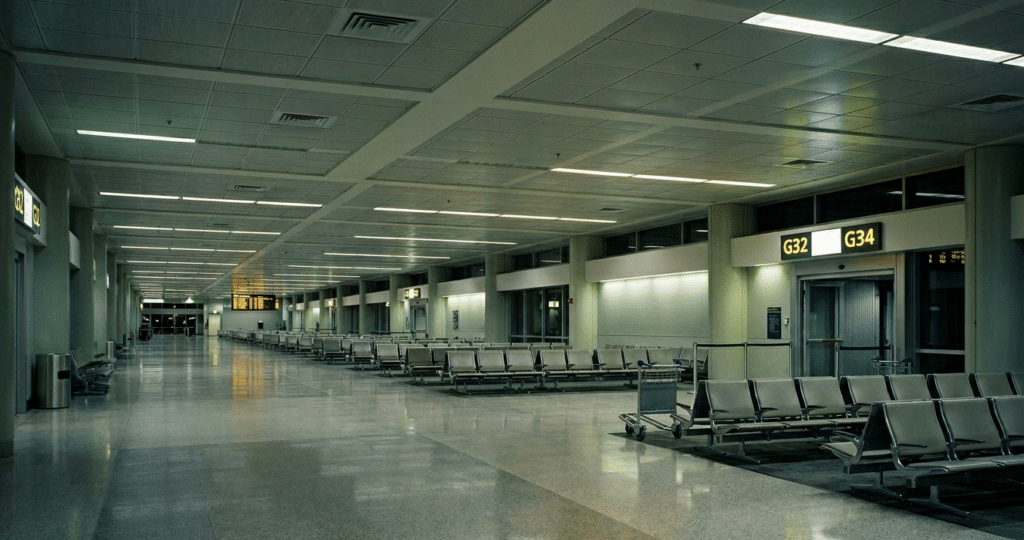
It’s 3:47 a.m. at Istanbul Airport and everything is open. The lights are on. The shops are staffed. A man is mopping a floor that doesn’t need mopping. This is a fully operational city that has agreed, collectively, to pretend it isn’t one — because if it admitted it was a city, you might start asking why nobody here seems to actually live in it. Nobody lives in an airport. Nobody is from an airport. And yet somewhere between two and three million people are inside one right now, at this exact moment, existing in a place that has no interest in being a place. This is not an accident. This is the design.
There is a word for what an airport is, and it predates airports by about a hundred years. Liminal — from the Latin limen, meaning threshold. The anthropologist Arnold van Gennep coined the concept in 1909 to describe a specific phase inside human ritual: the moment after you’ve left one state but before you’ve entered the next. He was writing about moments like the one just before a newly married couple opens the door to their first home together — the ceremony behind them, the life ahead, a key in someone’s hand, and nowhere to be yet. Van Gennep had no way of knowing that a century later, we’d be building enormous glass-and-steel structures specifically designed to put millions of people per day into that exact state. And then charging them fourteen euros for a sandwich while they were in it.
What makes airports genuinely fascinating — and I think they are genuinely fascinating, which I realize is not a universal view — is how precisely they replicate something humans have been doing deliberately for thousands of years, without anyone apparently deciding to do it on purpose. The threshold isn’t a design flaw. It turns out to be load-bearing.
How the Terminal Stopped Being a Place
The earliest commercial terminals were built to feel like destinations. London’s Croydon Aerodrome in the 1920s had the energy of a very confident building — the kind that knew you’d come a long way to get here and wanted you to feel the occasion. Flying was, to be fair, an occasion. The people doing it were mostly wealthy, often eccentric, and entirely aware that something remarkable was happening. The terminal reflected this. It said welcome rather than proceed to Gate B7.
Then aviation scaled. It stopped being spectacle and became infrastructure — which is a polite way of saying it became something that needed to move as many people through as efficiently as possible. The architecture followed. Drop ceilings. Carpet tiles in patterns designed to be inoffensive from any conceivable angle. Gate seating bolted directly to floors, because moveable seating implies the space has preferences, and a space with preferences is a space that thinks it’s somewhere. The same departure screens, the same typefaces, the same duty-free layout at Heathrow, Hanoi, and Houston. The goal, quietly but completely, had become throughput. And throughput, it turns out, is the enemy of place.
The French anthropologist Marc Augé wrote about exactly this in a 1992 book called Non-Places. His argument was that modernity had produced a new kind of space — defined not by what you are in it, but by what you do in it. Move. Consume. Wait. He called them non-lieux, and his central example was, naturally, the airport. The book reads now less like cultural theory and more like a design brief that every airport architect since has been quietly following. Which is either a remarkable piece of foresight or, well, a bit depressing, depending on how you look at it.
But here’s where Augé got it slightly wrong. He treated non-places as a deficit — a subtraction from authentic human experience. What he didn’t account for is how willingly, even eagerly, we inhabit them. The airport isn’t just a space we tolerate. It’s a space that, on some level, we seem to need.
What Actually Happens to You in There
Pay attention, next time you clear security, to what happens to your sense of self. It goes, to put it plainly, a bit offline. Nobody at Gate D14 knows you’re a bad texter, or that you owe someone an apology, or that you said something at work last Thursday you’ve been replaying ever since. You have no neighborhood reputation. No accumulated relational history. You are just a person with a boarding pass and a medium coffee, temporarily and rather pleasantly relieved of the burden of being specifically yourself.
This is, incidentally, why people confess things to strangers on planes. And cry in departure lounges. And call family members they haven’t spoken to in years — or used to, anyway, before payphones quietly disappeared, which is a whole other story.
If it were today, I’d put in my headphones and pretend to be asleep, but I once listened to a man explain, in careful detail, why he wasn’t going home. I thought he was just a talker. I know now he was doing exactly what the airport was built for. The pressure drops in airports in a way it doesn’t drop anywhere else, and when pressure drops, things that have been held in tend to come out. The airport doesn’t cause this. It just provides the conditions.
You put your watch in a plastic tray like it’s temporarily not yours. The security line is doing more work than it looks like. It takes your shoes, your belt, your jacket, your liquids — the small objects through which you signal, to yourself and others, who you are. It makes you stand in a machine that sees through your clothes. It is, if you think about it, a fairly thorough stripping-away of identity markers, followed by release into a space with nothing to ask of you. Van Gennep would have recognized it immediately. The ritual is running. Nobody gave it that name, but it’s running.
“The airport doesn’t cause this. It just provides the conditions — which is, when you think about it, more or less what all the best rituals do.”
The Light That Has No Opinion About Time
Every few gates, at 3 a.m., there is someone wearing sunglasses. Not as a statement. Just as a response. The light has given them no reason to take them off. Here is a specific fact about airports that I find, genuinely, a little staggering: the lighting inside a terminal is engineered to be constant. Shadowless. Seasonless. There is no sunset in Terminal 2. There is no Tuesday. The light at 3 a.m. is identical to the light at 3 p.m., and this is not an oversight — aviation discovered early that disoriented passengers spend more. When time stops existing, appetite takes over. The eternal noon is, to be quite straightforward about it, a revenue strategy.
And so the airport took the natural liminality of transit — the genuine suspension of identity that occurs when you’re between places — and monetized it. It built a container around the threshold state and filled it with duty-free perfume carousels, news shops stocking an implausible number of gummy candy varieties, and — at Istanbul Airport, at least — an evil eye shop and a baklava counter sitting directly next to a Louis Vuitton, which tells you everything you need to know about what kind of place this is. Or isn’t. The genius of this, and its particular absurdity, is that it works. I once bought a sandwich I didn’t even want, ate half of it standing up, and threw the rest away with the vague feeling that I had agreed to something I didn’t remember agreeing to. Price anchoring fails in airports. The normal mental calculation — what would I pay for this at home — simply doesn’t run. You are operating on backup systems. The fourteen-euro sandwich gets purchased. The overpriced neck pillow gets purchased. You hand over the money with a vague sense that the normal rules don’t apply here, which is correct, and also the point.
None of this, as it turns out, was invented by airports. The blueprint is older. Las Vegas casino designers figured it out in the 1960s: remove the windows, kill the clocks, eliminate any visual cue that might remind a person what time it is or that an outside world exists. Disorient the guest just enough to dissolve the normal mechanisms of restraint, and spending goes up. The airport looked at this model and, somewhere around the 1980s, quietly adopted it — with the added advantage that its guests had nowhere else to go. And then, a few decades later, Silicon Valley looked at both and built the same architecture into your phone. No windows there either. No clocks you didn’t put there yourself. The scroll that goes nowhere, the feed that never ends, the gentle dissolution of any sense that time is passing. Three different industries. One discovery. The airport just happened to be in the middle.
You Are, Right Now, a Race Condition
There’s a concept in computing called a race condition. It’s what happens when two processes try to operate on the same resource simultaneously, with no coordination between them, and the outcome depends entirely on which one resolves first. Neither process is wrong, exactly. The system just hasn’t decided yet.
Sitting at Gate D14 at 3:47 a.m., you are, in a fairly literal sense, a race condition. The city you left still has a version of you running in it — your apartment, your unanswered messages, the conversation you didn’t finish. The city you’re flying toward has a version of you waiting to be initialized. You, in the terminal, are neither. Both processes active. Neither committed. The system is holding two states in memory at once, waiting for you to land so it can work out which one wins.
This is, I think, why airports feel uncanny rather than merely inconvenient. The uncanny isn’t only about faces — it applies equally to time and place. An airport looks exactly like a public space, uses all the grammar of a public space, and then refuses to behave like one. Nobody is sitting on a bench for no reason. Nobody is loitering in the true sense. Everyone has a gate number, a destination, a boarding pass — all the apparatus of purpose — and yet nobody is going anywhere yet. It performs purposefulness while enforcing waiting. It is, to put it plainly, a loading screen. A very large, very expensive loading screen, with a Boots pharmacy in it.
The Ritual Nobody Calls a Ritual
Van Gennep’s key insight was that the liminal phase isn’t empty time. It is the most charged part of the entire ritual — the moment of maximum possibility, because nothing has been fixed yet. The old version of you has been formally dissolved. The new one hasn’t set. Every human society, across every culture that has ever been studied, has built a formal version of this. The between is not the gap in the process. It is the process.
The airport is the secular world’s most elaborate daily enactment of this, performed by millions of people who would find it quite strange to have it described that way. The stripping-away at security. The suspension in the departure lounge. The release, via a metal tube at 39,000 feet, into a new location where you will be — in some small or occasionally large way — a different person. The ritual is running. It has always been running. We just built a Starbucks inside it and stopped noticing.
The complication — and there is always a complication — is that we now carry our entire located selves through the threshold with us. We scroll. We post. We send our location to people who didn’t ask for it. We are trying, collectively and somewhat compulsively, to stay anchored to our normal identities while the architecture quietly insists we let go of them for a bit. Whether this is making us worse at transitions — worse at the psychological work of moving from one version of a life to another — is genuinely hard to say. In any case, it does seem worth asking.
“The ritual is running. It has always been running. We just built a Starbucks inside it and stopped noticing.”
Nowhere, at Scale
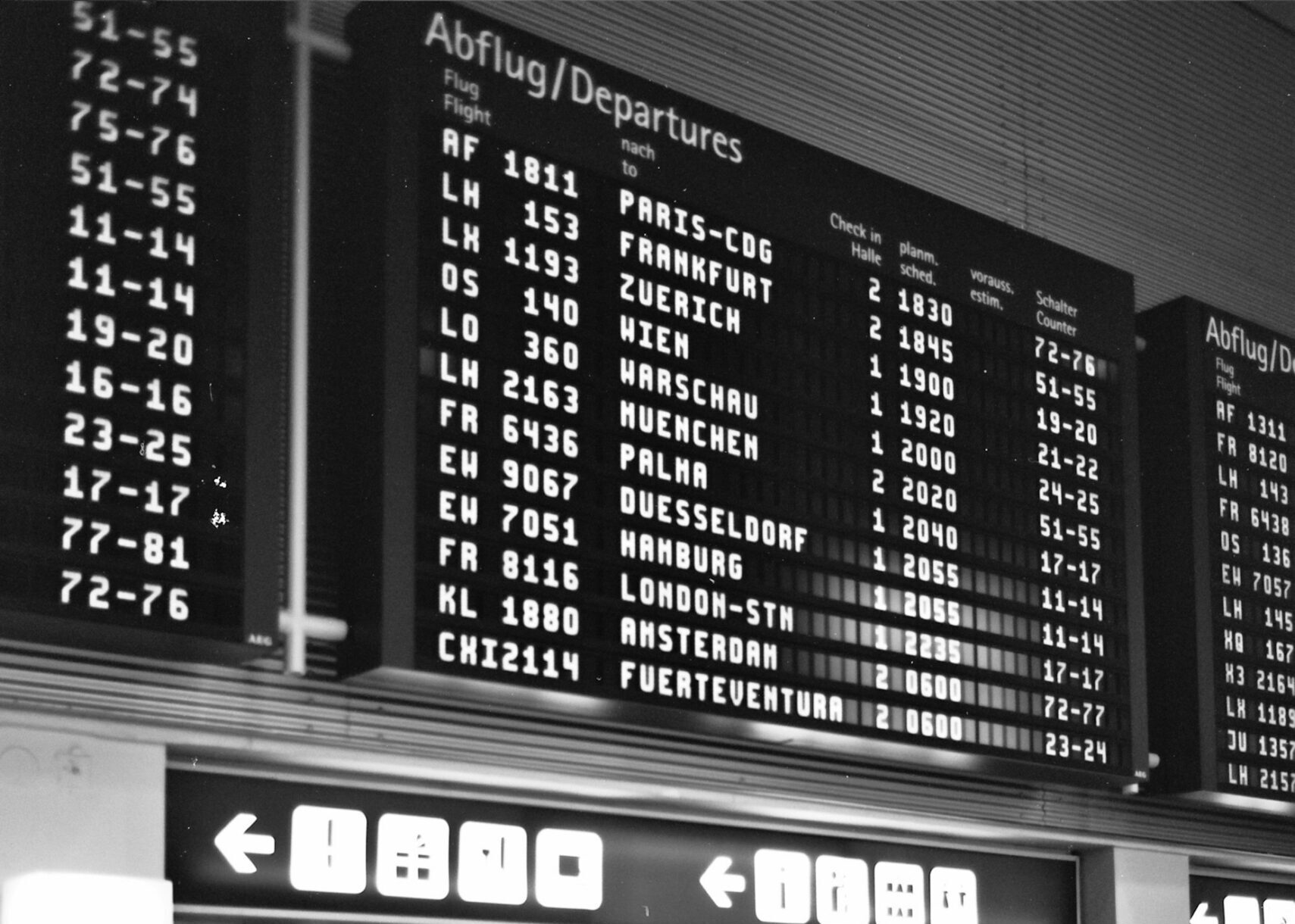
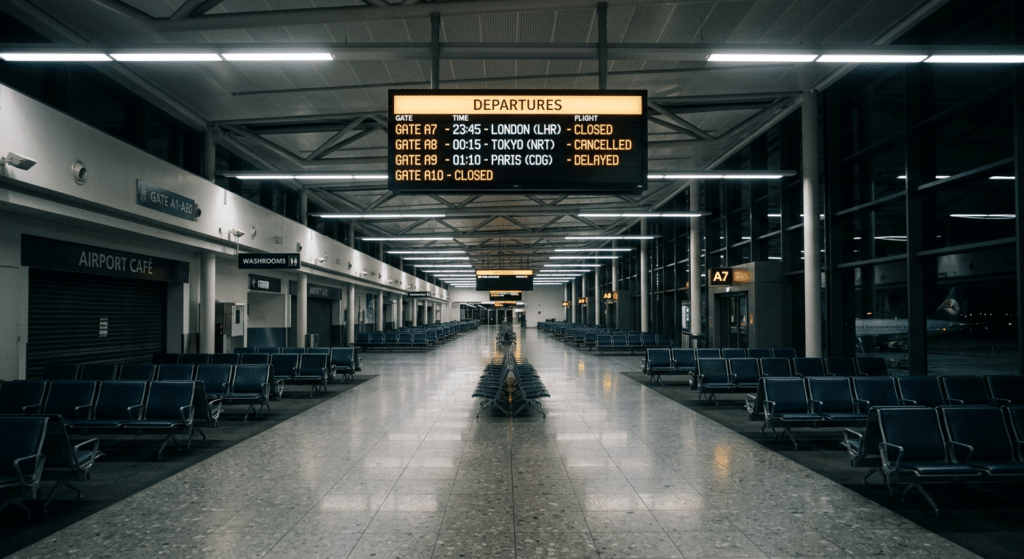
On a snowy winter morning, I remember sitting at a gate, watching the departures board cycle through cities nobody was going to anymore. Somewhere in the north, a volcano nobody had heard of until that morning — its name requiring what seemed like every consonant in the alphabet, several of them three times in a row — had quietly cancelled half of Europe. I was one of hundreds, all of us marooned in the same terminal, going nowhere. Mine, as it turned out, was just delayed. How many hours, the board wasn’t saying. I was already regretting leaving the lounge — regretting, specifically, the extra sugar I hadn’t put in my coffee, the larger menu I hadn’t ordered for a difference of five euros, the comfortable chair I had voluntarily abandoned for this one, which had been designed, with some conviction, to discourage extended sitting.
Outside, a snowstorm had sealed the city I’d come from. I couldn’t go forward. I couldn’t go back. And then the smell hit — something in the cleaner the man who is mopping a floor that doesn’t need mopping was using, something industrial and faintly sweet — and for a moment I was somewhere else entirely, somewhere much earlier, a corridor I hadn’t thought about in years. And somewhere in that strange little gap — stuck between a volcano and a snowstorm, in a terminal that doesn’t officially exist, at a time that wasn’t quite any time at all — something I’d been turning over for months just clicked into place. I boarded, eventually. I flew. I landed. But the decision had been made there, in the nowhere, while I was waiting for the board to change.
It’s 3:47 a.m. at Istanbul Airport and a man is still mopping a floor that doesn’t need mopping. The woman next to you takes off her sunglasses with a puzzled look on her face. There are a lot of people in a terminal somewhere right now — enough that it stops meaning anything. All of them between versions of themselves, waiting for a gate number that will release them back into their lives. The lights have no opinion about what time it is. Neither, for a moment, do you. This is not an accident. It’s the oldest technology humans have. We just gave it wi-fi and a duty-free, and called it an airport.