Why Do Humans Sacrifice? The Ancient Origins of Eid al-Adha Explained
Quick Summary
- The Arabic word qurban literally means “to draw near” — sacrifice was never about destruction, but about crossing the boundary between human and sacred.
- Ritual sacrifice emerged independently across Sumer, Vedic India, ancient Greece, and pre-agricultural Anatolia — suggesting it is a universal human instinct, not a borrowed tradition.
- Modern psychology identifies four core drivers behind sacrifice: costly signaling, communal bonding, anxiety management, and social redistribution — all still active in Eid al-Adha today.
Table of Contents
Why do humans sacrifice? It is one of the oldest questions anthropology has ever asked — and Eid al-Adha — observed by hundreds of millions of people each year — sits directly at its center. The answer reaches back further than any religion, any civilization, any written word.
A Father. A Knife. A Ram in the Thicket.
Before the first empire rose. Before the first alphabet was carved. Before wheat was planted or cities named — humans were already standing at the edge of the sacred, holding something valuable, and letting it go.
A Sumerian priest in Ur. A Vedic scholar feeding flames at dawn. A Hittite king pouring wine into cracked earth before battle. An Aztec elder at the summit of a pyramid under a bleeding sky.
None of these people ever met. None shared a language, a god, or a continent. And yet all of them were doing, in essence, the exact same thing.
This is the question that lives underneath Eid al-Adha, underneath every knife raised in the name of the sacred: Why do humans sacrifice?
What Does Qurban Mean? The Word Behind the Sacrifice
Etymology is where the ideology lives.
The Arabic word qurban — the term used for the Eid sacrifice — comes from the root q-r-b: to draw near. To approach.Sacrifice, in its original logic, is not destruction. It is a movement toward something. You give up what is valuable precisely because it is valuable. The offering must cost you something, or it means nothing.
Latin tells the same story. Sacrificium breaks into sacer (sacred) and facere (to make). To sacrifice is to make something sacred — to transfer an object from the ordinary world into the divine one. The act itself is a kind of translation. You are converting wealth into meaning.
Across languages and millennia, the logic is almost identical: there is a boundary between the human and the sacred, and the only currency that crosses it is loss.
Callout: Qurban does not mean “to kill” or “to give.” It means “to draw near.” The sacrifice is the movement, not the death.
Before Abraham: A Brief Tour of the Ancient World
Here is what makes the anthropological case so striking. Sacrifice did not spread from one civilization to the others like a contagion. It appeared — independently, spontaneously, almost everywhere — as soon as humans organized themselves into communities.
In Mesopotamia, the Sumerians maintained temple economies where animals were slaughtered daily for the gods. The theology behind it was remarkably transactional. The gods had created humans to feed them. Sacrifice was paying the bill. Cuneiform texts from Ur describe elaborate protocols: which animal, which day, which portion of the carcass goes to which deity. The divine bureaucracy needed feeding, and it kept very detailed receipts.
In the Vedic tradition, the yajna — the fire sacrifice — operated on entirely different logic. The Rigveda frames sacrifice not as a gift to the gods but as the mechanism that keeps the universe running. Fire is the bridge: smoke rises, rain descends, the cycle continues. Withhold the sacrifice and the cosmos begins to break down. This is not religion as transaction — it is religion as cosmic maintenance.
In ancient Greece, the thusia ritual contained a twist that the poet Hesiod preserved in myth. When Prometheus divided the first sacrificial ox, he gave the gods the bones wrapped in glistening fat — and kept the meat for humans. The gods accepted the arrangement, willingly or not. The Greek sacrifice was, fundamentally, a communal feast. The temple and the kitchen were the same room. The sacred meal and the political meal were the same meal.
In ancient Rome, the suovetaurilia — the sacrifice of a pig, a sheep, and a bull simultaneously — was performed before military campaigns and at the borders of new territory. The three animals together covered every category of land-based sacrifice, ensuring no divine authority was left unpaid.
In Anatolia, the evidence goes further back than all of these traditions combined. Göbekli Tepe — the roughly 12,000-year-old ritual complex in southeastern Turkey — predates agriculture, writing, and nearly everything we call civilization. Yet it holds massive carved pillars, animal imagery, and enormous quantities of animal bones suggesting ritual feasting on a grand scale. Archaeologist Klaus Schmidt, who excavated the site for decades, argued that the monument was not built by a settled society. It helped create one. The ritual gathering came first. The village followed.
If Schmidt was right, then sacrifice did not emerge from civilization. Civilization may have emerged from sacrifice.
Callout: Göbekli Tepe — 12,000 years old, predating agriculture — suggests that communal ritual sacrifice may be older than the village itself.
The Moment That Changed Everything
The story of Abraham and his son — told across Judaism, Christianity, and Islam in different forms — is one of the most psychologically intense narratives in all of religious literature.
A father. A child he loves beyond reason. A divine command that makes no sense. A three-day journey during which Abraham presumably thinks about nothing else.
And then, at the last possible moment: a ram, caught by its horns in a thicket. A substitution.
The story does not simply preserve a founding myth of a religious practice. It marks a threshold in moral history — the moment when the logic of sacrifice shifts from the most precious thing must be given to the willingness to give is enough. The ram dies. The son lives. The covenant is made not through death but through demonstrated readiness.
In Islamic theology, this moment is called the ikame — the substitution. Later scholars, particularly the Sufi thinker Ibn Arabi, pushed the interpretation further: the real sacrifice is not the animal. It is the ego. The attachment. The self that clings to what it possesses. The knife at the throat of the ram is, in this reading, a mirror pointed inward.
The Animals Themselves: A Layer of Symbolism
The specific animals of sacrifice were never chosen at random.
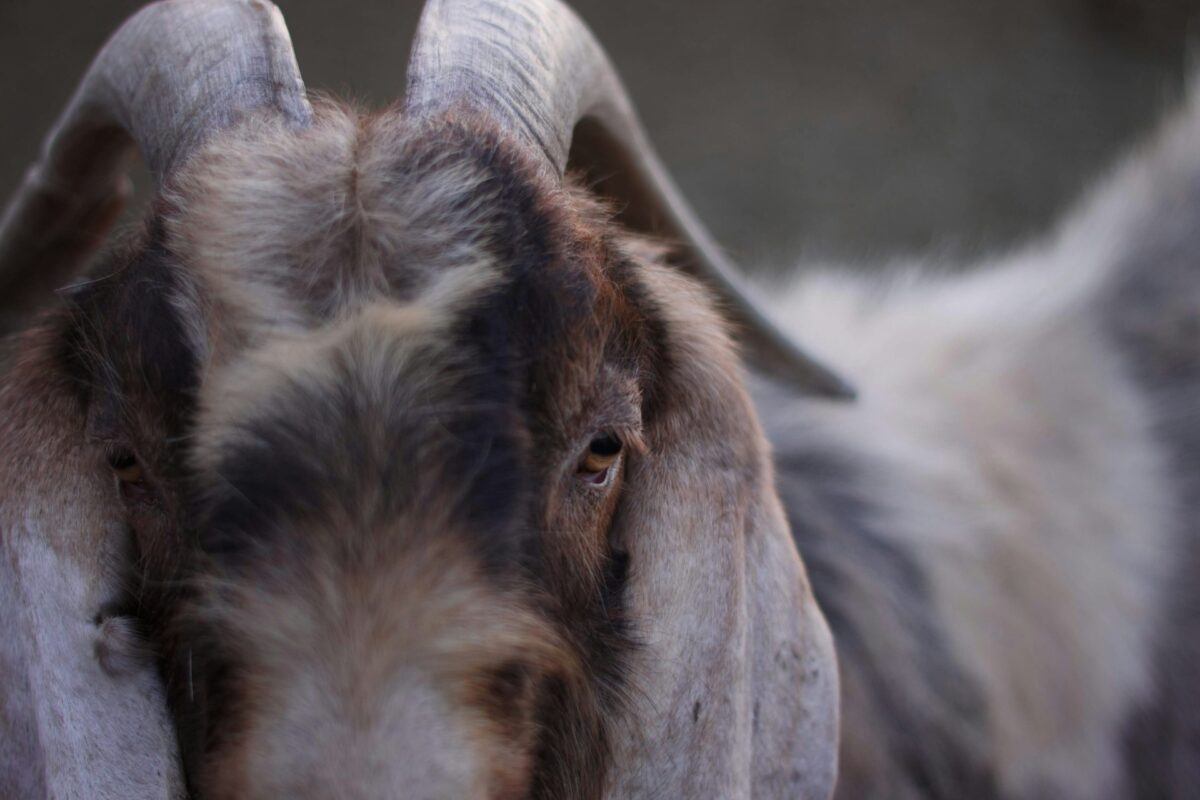
The ram carries one of the oldest symbolic loads in human history. In Mesopotamia, the ram-headed staff was an emblem of kingship and divine authority. In the Zodiac, Aries — the ram — marks the start of the solar year, the return of fertility and light. When a ram is sacrificed at Eid, it arrives dragging thousands of years of accumulated meaning behind it: power, leadership, the first warmth of spring.
The bull or ox appears across an even wider range of ancient cultures as the supreme sacrificial animal — in Egypt, in Minoan Crete, in Vedic India, in pre-Islamic Arabia. In many of these same traditions, the serpent moved alongside it as the other face of chthonic power — the creature that killed, cured, and kept the cosmos turning. The bull was the most concentrated form of worldly power a pastoral society could possess. To slaughter one for the gods was to surrender the most valuable thing you owned. When Roman generals celebrated military triumphs, they sacrificed white bulls on the steps of the Capitoline Temple. The magnitude of the offering was the point. Size was the message.
This symbolism did not evaporate when monotheism replaced the old gods. It was absorbed, reinterpreted, and carried forward — the same animals now speaking a new theological language.
Why Do Humans Sacrifice? The Psychology Behind the Ritual
To many modern people — particularly in societies where meat arrives vacuum-sealed and the act of killing has been industrialized out of sight — ritual sacrifice feels shocking. Primitive, even. But this discomfort is itself worth examining.
For most of human history, the death of an animal was visible, intentional, and ritualized precisely because it was understood to matter. The modern slaughterhouse kills far more animals than any ancient festival ever did — it simply does so behind walls. What changed is not the killing. What changed is the honesty about it.
Anthropologists and evolutionary psychologists have spent decades asking why sacrifice is so persistent across so many cultures and eras. Several answers have emerged.
Costly signaling. The sacrifice proves your commitment to the group precisely because it is wasteful. Anyone can claim loyalty. Killing your best animal — or, historically, something far more precious — demonstrates that your investment in the community is real. The more it costs, the more convincing it is. This theory, developed extensively by scholars including Richard Sosis in his cross-cultural studies of ritual behavior, explains why sacrifice has to hurt. A painless sacrifice is, by definition, no sacrifice at all.
Communal bonding through shared transgression. Killing a large animal is a transgressive act. Doing it together, inside a ritual frame that marks it as sacred rather than merely violent, creates a form of moral solidarity. You have done this together. You are bound by it. The act forges a relationship that verbal commitment alone cannot.
The management of guilt and anxiety. Pre-modern humans lived inside radical uncertainty — drought, disease, war, infant mortality. The sense that one had failed to give enough to the forces governing the world was never far away. Sacrifice created a structured outlet: here is what I owe, here is what I give, the account is now settled. The psychological relief was real, regardless of whether any god received the offering.
Redistribution. Most practically: the portion given to the gods was smoke and bones. The rest was eaten — by priests, by the poor, by the entire community gathered at the temple. In societies where protein was scarce and meat was rare, the sacrificial festival was often the only occasion when the whole social spectrum ate the same food at the same table. Eid al-Adha’s division of the slaughtered animal into three equal portions — one for the family, one for neighbors, one for the poor — is not a modern humanitarian gloss on an ancient practice. It is the oldest logic of sacrifice made explicit.
Callout: The three-portion division of the Eid sacrifice — family, neighbors, the poor — mirrors the redistributive logic of sacrificial festivals across the ancient world.
Eid al-Adha Today: Why the Living Ritual Still Works
What is remarkable about Eid al-Adha is not that it survived. Many ancient rituals survived — fossilized, drained of meaning, performed out of habit. What is remarkable is that for hundreds of millions of people, it still carries genuine weight.
The smell of the morning. The specific gravity of the knife. The distribution of meat to someone you do not know but are now connected to through the act itself. The way children watch and ask questions. The way grandparents try to answer.
The ritual endured not because it was commanded — many commanded things disappear — but because the human emotions underneath it never went away. The need to mark what is most valuable. The need to give something real as a sign of real commitment. The need to eat together after loss and call it abundance.
Every civilization that ever looked up at the sky and felt the unbearable smallness of being human invented some version of this. They brought their best animal, their best grain, their best self, to the edge of what they could not understand — and offered it.
The theology changes. The feeling underneath it does not.
Did You Know?
The oldest evidence of large-scale ritual animal sacrifice predates the earliest known writing systems by roughly 6,000 years. Göbekli Tepe, the 12,000-year-old site in what is now southeastern Turkey, contains the butchered bones of hundreds of aurochs, gazelles, and wild boar — not discarded as waste, but arranged in patterns that archaeologists interpret as ceremonial feasting. The people who built it had no pottery, no permanent homes, and no agriculture. They had, apparently, already developed a theology that required feeding something larger than themselves.
FAQ
What does Eid al-Adha commemorate?
Eid al-Adha commemorates the moment God substituted a ram for Abraham’s son at the last possible second — a test of absolute submission that became the founding act of the holiday.
Why is animal sacrifice performed on Eid al-Adha?
The sacrifice, called qurban, physically reenacts Abraham’s willingness to give up what he loved most — the animal stands in for the ego, the attachment, the thing each person is most reluctant to surrender.
Is Eid al-Adha sacrifice unique to Islam?
No. Ritual animal sacrifice appears independently in ancient Mesopotamia, Vedic India, ancient Greece, pre-colonial Africa, and pre-Columbian America — suggesting it is a near-universal human impulse, not a practice unique to any one tradition.
What happens to the meat after the Eid sacrifice?
Islamic tradition divides it into three equal portions: one for the immediate family, one for friends and neighbors, and one for those in need — a built-in redistribution mechanism that mirrors ancient sacrificial feast traditions worldwide.
Who can perform the Eid al-Adha sacrifice?
Any adult Muslim who meets the nisab threshold (a minimum of wealth) is required to offer the sacrifice; it can also be performed on behalf of an entire family unit.
Why must the sacrificial animal meet specific conditions?
The animal must be of sound health, of a minimum age, and free from defect — conditions that echo ancient sacrificial protocols from Rome, Greece, and Mesopotamia, where a flawed offering was considered an insult to the divine.
Does the concept of sacrifice appear in Christianity?
Yes — and at its center stands the same symbolic logic. In Christian theology, the crucifixion of Christ is understood as the ultimate sacrifice: a willing death that redeems humanity. The cross began as Rome’s instrument of public shame before becoming the world’s most recognized sacred symbol.