Labyrinth Symbol Meaning: Myth, Psychology, and Why We Keep Building Them
Quick Summary
- The word maze originally meant mentally dazed — humans named the building after what it did to the mind, not the other way around.
- Cultures across five continents built labyrinths for radically different reasons: ritual surrender, containment of danger, spiritual protection, power display, and — eventually — pure entertainment.
- The labyrinth and the maze are not the same thing: A labyrinth is unicursal — one winding path, no dead ends, no wrong turns. A maze is multicursal — branching paths, dead ends, and deliberate confusion. One is a meditation. The other is a trap.
Something chases you. You don’t know what it is. You run — left, right, another left — and every corridor looks exactly like the last one. This is the dream. Most people have had it. The labyrinth doesn’t need mythology to explain itself. It already lives inside you.
But it also lives in stone, in hedge, in mosaic, in cathedral floor. Humans have been building versions of it for at least 4,500 years — on rock faces, in royal palaces, inside churches, in fields of corn. No other architectural concept has survived so many civilizations, or meant so many different things to each of them. To understand why, you have to start not with the structure but with the word.
Maze vs Labyrinth: What’s the Difference?
Maze and labyrinth. Most people use them interchangeably. They shouldn’t — and the distinction cuts to the heart of what these structures actually do to us.
Maze entered Middle English around the 13th century from the Old English amasod: dazed, stupefied, mentally bewildered. It described a state of mind first. A physical structure second. When medieval English speakers called someone “mazed,” they meant unhinged, lost in thought, stunned into confusion. The building came later. The word came from the feeling.
Labyrinth is older and more architectural — borrowed from the pre-Greek language of the Minoans, tied from the beginning to specific walls, specific rituals, specific stone. Where maze starts in the mind and reaches outward, labyrinth starts in the earth and reaches inward.
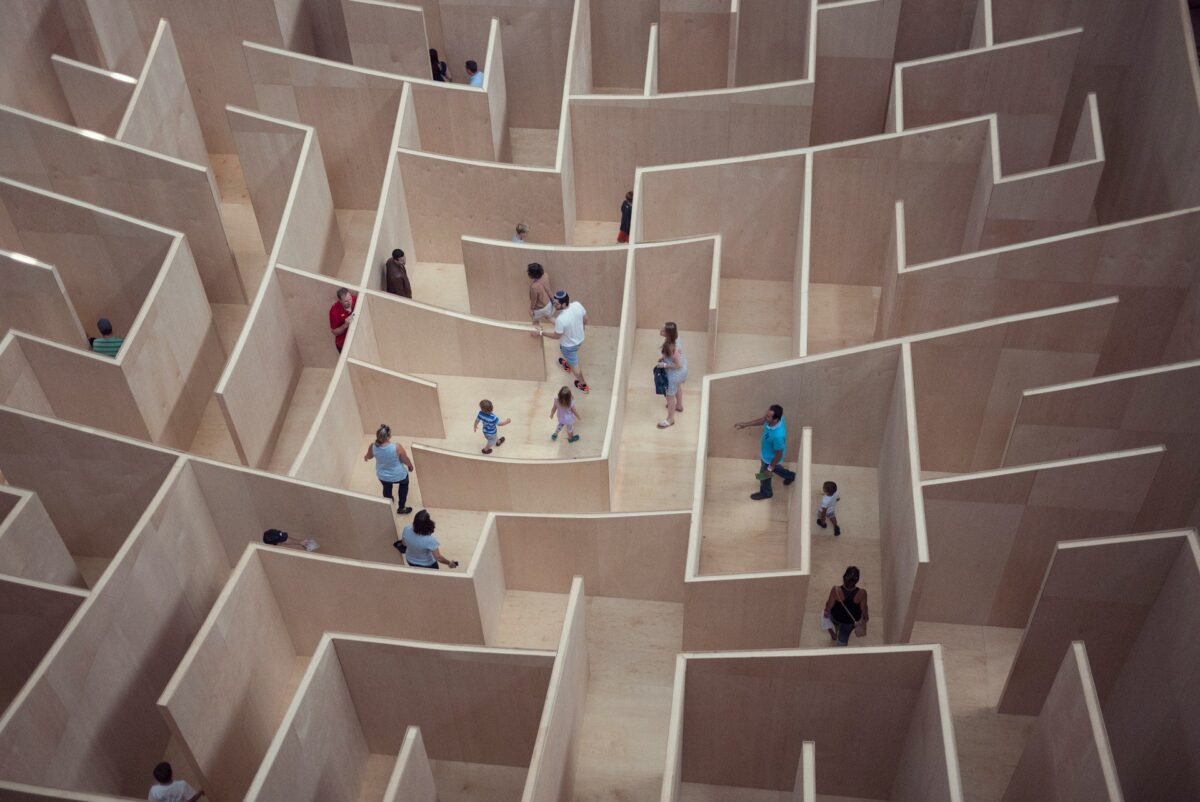
The crucial structural difference: a labyrinth is unicursal — one winding path, no branches, no dead ends, no wrong turns. You follow it to the center and follow it back out. A maze is multicursal — forking paths, dead ends, deliberate confusion. One is a meditation. The other is a trap.
Key Insight: The word maze named a mental state before it named a place. Humans built the structure to match the feeling — not the other way around.
This matters because it tells you which came first: the experience of disorientation, or the architecture that produces it. The answer is the experience. Every labyrinth ever built is, at bottom, an attempt to make the inside of a confused mind visible.
Why Did Ancient Cultures Build Labyrinths?
Across cultures and millennia, the labyrinth served five distinct purposes. They don’t overlap cleanly — each civilization chose the function that matched its deepest fear, or its deepest desire.
Ritual passage. The oldest use. The unicursal labyrinth is not a puzzle — it’s a pilgrimage compressed into a small space. The walker surrenders navigation entirely. One path, no choices, no wrong turns. The point was not to solve anything but to submit to the walk, to let the body trace the spiral while the mind released its grip on direction. Medieval pilgrims at Chartres Cathedral walked the floor labyrinth on their knees as a substitute for the journey to Jerusalem — the center of the spiral stood in for the holy city. The walk itself was the prayer.
Containment of the unbearable. Minos didn’t kill the Minotaur — he housed it. The labyrinth as prison for the thing a society cannot face is one of the most durable human impulses. The structure doesn’t eliminate the threat; it buries it, walls it off, gives it a home deep enough underground that the surface can pretend it isn’t there. This is why Carl Jung recognized the labyrinth immediately as a map of the psyche: the unconscious is not empty space — it holds something, and the architecture is built to keep that something contained.
Protection from hostile forces. Swedish and Finnish coastal communities constructed stone labyrinths — trojaborgar — before setting out to sea. Local tradition held that malevolent spirits, compelled by their nature to follow every path, would become trapped in the spirals. The fishermen walked out. The spirits stayed in. The labyrinth as spiritual filter: danger enters, becomes lost, never leaves.
Power and display. Amenemhat III’s funerary complex at Hawara, Egypt — a structure Herodotus visited in the 5th century BCE and declared more astonishing than all the works of Greece — covered a footprint larger than any pyramid. Three thousand rooms, half of them underground. Its sheer incomprehensibility was the point. The man who commands a structure no one else can navigate commands awe. Roman villa owners decorated their floors with mosaic labyrinths for the same reason: complexity as a status symbol, the myth as a calling card.
Play. The Renaissance hedge maze — genuinely multicursal, full of dead ends, designed to frustrate — transformed the labyrinth from sacred to recreational. Hampton Court’s maze, planted in the 1690s for William III, exists purely for the pleasure of getting lost. Here the labyrinth shed every ritual and political meaning and kept only the sensation. The monster was gone. The thrill of disorientation remained — now purchasable, now suburban, now made of corn.
Key Insight: Every labyrinth ever built served one of five functions — and which function a civilization chose reveals exactly what it feared most: death, the unconscious, malevolent spirits, political rivals, or simply boredom.
Real Labyrinths in History (Timeline)
The myth is vivid. The real structures are stranger — and they predate the story by centuries.
c. 2500 BCE — Galicia, Spain The oldest known labyrinth image: a seven-ring unicursal spiral carved into Atlantic coastal rock. No myth attached. No monster named. Just the pattern, already fully formed, already staring back.
c. 1800 BCE — Hawara, Egypt Pharaoh Amenemhat III builds a funerary complex of such bewildering scale that Herodotus, visiting 1,300 years later, runs out of language. Three thousand rooms. Half underground. Some scholars believe the Greek word labyrinth was borrowed not from Crete but from the Egyptian name for this structure.
c. 1400 BCE — Knossos, Crete The palace of Minos: 1,300-plus rooms, multiple storeys, light wells, storage corridors, ceremonial staircases. No underground maze has ever been found beneath it. Archaeologist Arthur Evans believed the building’s sheer complexity generated the myth. The labyrinth was the palace. The palace was the labyrinth.
c. 1201 CE — Chartres, France The cathedral’s floor labyrinth: eleven circuits, 261.5 meters of path folded into a circle 12.8 meters wide. Pilgrims walk it on their knees. It becomes the definitive model for Christian contemplative labyrinths across Europe.
1690 CE — Hampton Court, England The world’s oldest surviving hedge maze, planted for William III. Genuinely multicursal. Still open. Still getting people lost. The labyrinth, at this point, has completed its full transformation from sacred architecture to afternoon entertainment.
The most famous of these structures, however, was never found. Only the story survived.
The Minotaur and the Labyrinth: What the Myth Really Means
King Minos of Crete failed a god. Poseidon sent him a magnificent white bull to sacrifice. Minos kept it. The punishment was grotesque: the god made Minos’s wife, Pasiphaë, fall violently in love with the animal. The Minotaur — half man, half bull — was the result.
Minos commissioned Daedalus, the greatest craftsman alive, to build a structure from which nothing could escape once inside. The Minotaur went in. Athens, conquered by Crete, paid tribute: seven young men and seven young women, sent every nine years to feed what lived below.
Theseus volunteered. Ariadne, Minos’s daughter, gave him a ball of thread — her clew — to trace his path back. He killed the Minotaur. He found the thread. He escaped.
Read as architecture, the myth is about what the labyrinth was actually built to do: not to trap heroes, but to hide shame. The Minotaur is Minos’s sin made flesh — the consequence of his failure, the proof of his wife’s disgrace, the royal family’s most unspeakable secret. The labyrinth doesn’t eliminate the problem. It manages it. It keeps the unbearable thing alive but invisible, fed but contained, real but deniable.
Three thousand years later, the structure still works. We just changed what we put inside it.
Labyrinth Symbol Meaning Across Cultures
The labyrinth has accumulated so many symbolic meanings that they have begun to argue with each other. That tension is the point.
Death and rebirth. The labyrinth is underground, dark, disorienting — all the qualities that ancient cultures associated with death. Walking in is dying. The center is the grave. Walking back out is resurrection. Initiation rites across the ancient world used labyrinthine structures for exactly this reason: you entered as one thing and exited as another, symbolically killed and reborn inside the spiral.
The unconscious self. Jung argued that every hero myth enacts the same psychological drama: the ego descends into the unknown interior, confronts what it finds, and returns transformed. The labyrinth is the unconscious made visible. The Minotaur is the shadow — the repressed, the monstrous, the disowned. Theseus’s thread is the fragile connection to the surface world, to the self that still functions in daylight.
Complexity as control. Whoever designs the labyrinth controls who gets lost. Daedalus knows the way out. Minos knows what’s inside. Everyone else is prey. The labyrinth as bureaucracy, as legal system, as power structure — a thing so deliberately complex that navigating it requires knowledge only the powerful possess.
Disorientation as preparation. Here the symbol inverts itself entirely. Some traditions celebrate the labyrinth not as trap but as teacher. The medieval pilgrim crawling Chartres’s spiral on her knees was not being punished by the complexity — she was being prepared by it. You cannot find your center without first losing your bearings. The confusion is the curriculum.
These four meanings are not compatible. A symbol of death cannot simultaneously be a tool of healing. A structure of political domination cannot also be a path to spiritual surrender. The labyrinth holds all four meanings at once because different people encounter it at different moments of their lives — and what you find at the center depends entirely on what you brought in with you.
Key Insight: The labyrinth’s four symbolic meanings — death, the unconscious, power, and preparation — directly contradict each other. It has survived 4,500 years precisely because it is large enough to hold all of them.
What Happens in Your Brain When You Get Lost
The labyrinth persists as a symbol because it accurately describes something that happens inside the brain. Cognitive scientist George Lakoff’s concept of conceptual metaphor explains why spatial disorientation and emotional confusion feel identical: we are lost in grief, we can’t find our way out of depression, we wander through indecision. The language is not poetic. It is structural.
The hippocampus — the brain region that handles spatial navigation — is also central to emotional memory and personal narrative. Neuroscientist John O’Keefe’s Nobel-winning discovery of place cells showed that specific neurons fire only when you occupy a specific location in space: the brain builds a live map of wherever you are. The same neural system that tracks where you are also tracks who you are. And because the hippocampus evolved primarily as a survival tool — mapping escape routes, tracking threats, encoding dangerous terrain — spatial disorientation doesn’t just feel uncomfortable. The brain processes it as a threat to life. Getting lost in a maze and getting lost in yourself are, at the neurological level, the same kind of problem processed by the same architecture.
This is why walking labyrinths have been used therapeutically since the 1990s. Hospitals, hospices, and psychiatric facilities across the US and Europe have installed them. A 2017 study in the Journal of Holistic Nursing found measurable reductions in anxiety in patients who walked labyrinth paths. The mechanism is not mystical: the unicursal path removes all decision-making. For a mind overwhelmed by the feeling that every choice is a potential catastrophe, that single path is a form of relief so basic it borders on the physiological.
The Labyrinth Across Cultures
Hopi (North America): The “Man in the Maze” — a figure at the entrance of a square spiral — represents the full human journey from birth to death. The twists are life’s challenges. The center is death. Turning back from the center represents the sun returning, and life beginning again.
Hindu Tradition: The Chakravyuha, described in the Mahabharata, is a military formation shaped like a labyrinth. The young warrior Abhimanyu knew how to enter but not how to exit. He died inside it. The myth frames the labyrinth as a trap built from asymmetric knowledge — the deadliest kind.
Celtic Europe: Spiral carvings on Neolithic passage tombs — Newgrange in Ireland, Brú na Bóinne — echo the unicursal labyrinth form and align with solar events. The spiral marks the threshold between the living and the dead, the same threshold the labyrinth has marked everywhere humans have built it.
Modern Pop Culture: Kubrick’s The Shining (1980) puts the monster inside the father. Borges made labyrinths his entire literary project — infinite libraries, forking garden paths, time itself as a multicursal maze. Del Toro’s Pan’s Labyrinth(2006) asks whether escape into myth is indistinguishable from death. The structure keeps generating new stories because it keeps describing the same thing: the mind trying to locate itself inside itself.
The Modern Labyrinth: Bureaucracy, Systems, and Getting Lost Today
Modern life made a promise: if you optimize well enough, you will never get lost.
GPS reroutes before you miss the turn. Algorithms predict the next song, the next purchase, the next person you might love. Productivity systems break every goal into linear steps with measurable outcomes. The whole architecture of contemporary life is designed around one assumption — that disorientation is a problem to be solved, not an experience to be had.
By that logic, the labyrinth should be dead. And the physical labyrinth largely is. Nobody wanders. Nobody surrenders navigation. Getting lost is a failure state, not a ritual.
But something strange happened on the way to total optimization: the labyrinth didn’t disappear. It metastasized.
The healthcare system that takes fourteen steps and six referrals to see a specialist. The legal process designed so thoroughly around insider knowledge that navigating it without a guide is essentially impossible. The corporate hierarchy where decisions loop back on themselves, where accountability vanishes into corridors that lead nowhere, where the person who actually knows the answer is three departments and two approval chains away. These are not accidentally complex. Complexity, as Minos understood, is a form of power. The people who built the system know the way out. Everyone else is prey.
The labyrinth didn’t die with the Minotaur. It put on a suit.
And yet — the hunger for the labyrinthine experience, the chosen disorientation, has never been more visible. Meditation retreats sell the deliberate silencing of the GPS mind. Slow travel movements push back against the itinerary, against the optimized route. Forest bathing, aimless walking, analog journaling — these are all attempts to recreate, in controlled doses, the sensation of not knowing exactly where you are. The market for productive lostness is booming precisely because the rest of life has become so relentlessly, exhaustingly legible.
Modern life didn’t kill the labyrinth. It split it in two. The maze is now something done to you — by systems, by bureaucracies, by designed complexity in service of power. And the labyrinth is something you now have to seek out — because the default state has become so straight, so fast, so frictionless that the ancient experience of not-knowing-where-you-are has become a luxury.
Daedalus built one labyrinth. We built millions. We just stopped calling them that.
Fun Fact
The English word clue comes directly from the labyrinth myth. The Old English clew meant a ball of thread or yarn — specifically the kind Ariadne gave Theseus to navigate back out of the labyrinth. When detectives began using the word to mean guiding evidence, they were invoking, without knowing it, a thread that leads through the dark toward a monster.
Frequently Asked Questions
What is the difference between a labyrinth and a maze?
A labyrinth is unicursal — one winding path, no dead ends, no choices. A maze is multicursal — branching paths, dead ends, deliberate confusion. One is a meditation. The other is a puzzle.
Where does the word “maze” come from?
From the Old English amasod, meaning dazed or mentally bewildered. It described a state of mind centuries before it described a physical structure.
Why did ancient people build labyrinths?
For five distinct reasons depending on culture: ritual passage, containment of danger, protection from hostile spirits, display of political power, and — from the Renaissance onward — entertainment.
Did the labyrinth of Knossos actually exist?
No underground maze has been found beneath Knossos. Archaeologist Arthur Evans believed the palace’s own complexity — over 1,300 rooms — generated the myth. The building was the labyrinth.
What does the labyrinth symbolize?
Death and rebirth, the unconscious mind, political control through complexity, and productive disorientation — four meanings that contradict each other, which is precisely why the symbol has lasted 4,500 years.
Are labyrinths used in therapy?
Yes — hospitals and hospices across the US and Europe use walking labyrinths to reduce anxiety, supported by a 2017 study in the Journal of Holistic Nursing. The unicursal path removes all decision-making, which produces measurable calm.