Triangle Symbol Meaning: The Shape Every Civilization Decided Was Sacred
The triangle symbol represents power, direction, and transformation. Pointing upward it signals ascent, fire, and the divine masculine. Pointing downward it signals water, the feminine, and earthly matter. Across Ancient Egypt, Hinduism, Christianity, and Freemasonry, it consistently appears at the center of sacred geometry — making it the most universally adopted geometric symbol in human history.
Table of Contents
Why Does the Triangle Symbol Feel Like It’s Moving?
Three points. Three lines. The simplest polygon geometry allows.
Yet the triangle symbol has never been simple. It appears on the walls of Egyptian tombs and the backs of dollar bills. It floats above the eye of God in Masonic lodges and glows on the cover of The Dark Side of the Moon. It marks hazard signs and holy trinities alike. It structures sacred geometry from the Sri Yantra to the Pythagorean tetractys. It anchors esoteric symbols from alchemy to Freemasonry.
Cultures that never spoke the same language, never shared a trade route, never knew the other existed — they all arrived at the triangle and decided it meant something.
That may not be coincidence. It may be visual perception catching something structural — a shape the eye reads as motion before the mind reads it as meaning. Or it may simply be that a shape which never falls down looks eternal. Either way, the triangle keeps demanding an answer.
What Does the Triangle Symbol Mean?
The Linguistic Roots: More Than Just a Shape
The word triangle enters English through Latin triangulum — from tri (three) + angulus (angle, corner). But angulus itself traces back to the Proto-Indo-European root ang-, meaning “to bend” — the same root behind ankle, the point where the body changes direction.
At its linguistic core, the triangle isn’t a shape. It’s three bends. Three moments of forced redirection.
Some scholars argue this framing mattered to early thinkers. Rather than cataloging geometric forms, they may have been reading forces — and a triangle, in that reading, was not a passive figure but a diagram of change caught mid-motion.
The Primary Plane: Why Geometry Starts with Three
There’s a philosophical reason the triangle held such gravitational pull. Boethius, drawing on Platonist theory, identified the triangle as the primary plane surface — the first true shape, preceding the square, the pentagon, everything else. More than that: any geometric figure, however complex, can be broken into triangles by drawing lines from its center to its angles. The triangle doesn’t just appear in other shapes. It underlies them. Every polygon is, in the end, a collection of triangles in disguise.
Origins of the Triangle Symbol: From Ancient Geometry to Sacred Meaning
Ancient Egypt: Triangles as Cosmological Machines
Egypt made that weight monumental. The pyramids at Giza — triangular in profile — were built as cosmological structures. Their sloped faces were oriented with astronomical precision; some researchers suggest possible alignments with significant star positions, though the exact intended targets remain debated among Egyptologists. What’s less debatable is the symbolic intent: the triangle pointed upward, and ascending was the entire point.
The Pythagorean Tetractys: Mathematics as Sacred Oath
In Ancient Greece, the Pythagorean school treated triangles as the building blocks of reality. The tetractys — a triangular arrangement of ten points in rows of 1, 2, 3, and 4 — was considered a map of cosmic order, encoding the ratios of musical harmony. Pythagoreans reportedly swore their most sacred oaths by it, not by the gods.
Hindu Cosmology: Shiva, Shakti, and the Sri Yantra
Hindu cosmology produced the Sri Yantra: nine interlocking triangles radiating from a central point. Five point downward, representing Shakti (feminine, receptive energy). Four point upward, representing Shiva (masculine, active energy). The two sets also carry a deeper metaphysical distinction — purusha (pure spirit) and prakriti (matter, the material world) — held in perpetual dynamic tension. When two triangles meet apex-to-apex rather than interlocking, they form the shape of Shiva’s damaru (the hourglass drum), and their meeting point becomes the bindu — the seed-point of all manifestation, the moment before creation becomes form.
Boethius and the Platonist tradition identified the triangle as the primary plane surface — the foundational shape from which all other geometric figures are built. Every polygon, however complex, is ultimately a collection of triangles.
Is the Triangle Symbol Sacred or Just Structural?
Not everyone who reached for a triangle was reaching toward the sacred.
The more pragmatic reading says we venerate the triangle because it doesn’t collapse. Among all polygons, the triangle is the only inherently rigid shape. Apply pressure to a square and it deforms into a parallelogram. Apply pressure to a triangle and it holds. Bridge trusses, roof rafters, bicycle frames — all built on this principle. Engineers call it triangulation: the technique of using triangular members to distribute load and resist deformation.
This structural primacy connects directly to Boethius’s philosophical claim. The triangle isn’t just the first shape — it’s the strongest shape. Those two facts may not be unrelated. A form that underlies all geometry and refuses to deform under pressure will inevitably look fundamental. It will look like the shape reality is made of.
Some anthropologists propose that the triangle’s sacred status emerged not from mystical insight but from structural observation. Early builders noticed that triangular configurations — mountain peaks, tent poles, stacked stones — were the most stable forms in the natural landscape. Stability looked like permanence. Permanence read like the divine.
On this reading, the triangle’s spiritual power wasn’t discovered. It was projected — onto the only shape that refused to fall down.
Triangle Symbol Meaning in Psychology
Visual perception science offers a clear explanation for the triangle’s psychological pull.
Directionality is the core mechanism. A triangle always points somewhere. Squares sit. Circles contain. But a triangle has an apex — a terminus — and studies suggest the human visual system orients toward it almost immediately upon exposure. Upward-pointing triangles read as aspiration, growth, ascent. Downward-pointing triangles trigger associations with instability, danger, descent.
This is why warning signs across most cultures default to triangular forms — the shape activates alertness before the content is processed.
Psychologist Rudolf Arnheim, in Art and Visual Perception, described what he called directed tension in triangular compositions — a sense of visual energy moving toward the apex rather than resting in the form. Unlike the circle’s self-contained balance or the square’s static weight, the triangle reads as mid-motion.
Arnheim called this “directed tension” — the triangle doesn’t just sit in a visual field; it pulls attention toward its apex, making it the only common geometric shape that behaves like a verb rather than a noun.
There’s also the cognitive efficiency of triads. Human working memory processes groups of three with unusual reliability — rhetoricians have exploited this for millennia (veni, vidi, vici; beginning, middle, end; stop, drop, roll). The triangle makes the triad visible. It gives three a body. This may explain why so many sacred trinities were eventually drawn as triangles: the shape was the most natural container for the concept.
The triads the triangle has been made to carry are telling in their consistency: past, present, future. Birth, maturity, death. In alchemy: salt, sulphur, mercury — the three principles underlying all matter. In Freemasonic moral philosophy: wisdom, strength, beauty. Different vocabularies. The same triangular architecture underneath.
Upward vs. Downward Triangle Meaning: A Symbol That Flips
The triangle doesn’t carry one meaning. It carries two opposing ones — and the direction it faces determines everything.
The upward triangle (△) points toward the sky. Fire, masculinity, solar energy, ascent — these are its consistent associations across alchemical, Hindu, and Neoplatonic systems. In Christian iconography, some theologians mapped it onto Christ’s divine nature: the apex reaching upward, toward the Father. The triangle strives.
The downward triangle (▽) pulls toward the earth. Water, femininity, the womb — the yoni in Hindu tradition — and in Christian symbolism, Christ’s human nature: incarnate, earthward, dwelling among matter. The triangle receives.
Combining both triangles creates the Star of David — called the Seal of Solomon in esoteric traditions — where fire and water, spirit and matter, masculine and feminine are held in geometric equilibrium. In Hindu metaphysics this union represents Shiva and Shakti. In alchemical terms it marks the “plane of manifestation” — the threshold where opposites stop being opposites and become creation.
That double-triangle symbol migrated from alchemical manuscripts into Jewish identity and eventually into Freemasonic visual vocabulary — a single geometric figure carrying the history of three distinct traditions simultaneously.
The Triangle Symbol Meaning in Different Cultures
The cross-cultural presence of the triangle is striking — and the variations reveal as much as the commonalities.
Christianity uses the equilateral triangle — all sides equal, all angles identical — to represent the Holy Trinity: Father, Son, Holy Spirit. The equality of sides does theological work: it asserts the co-equal nature of the three persons without privileging any one. Medieval church art depicted God the Father haloed in triangular form, or rendered the Trinity as three interlocking triangles. The shape argued doctrine without words.
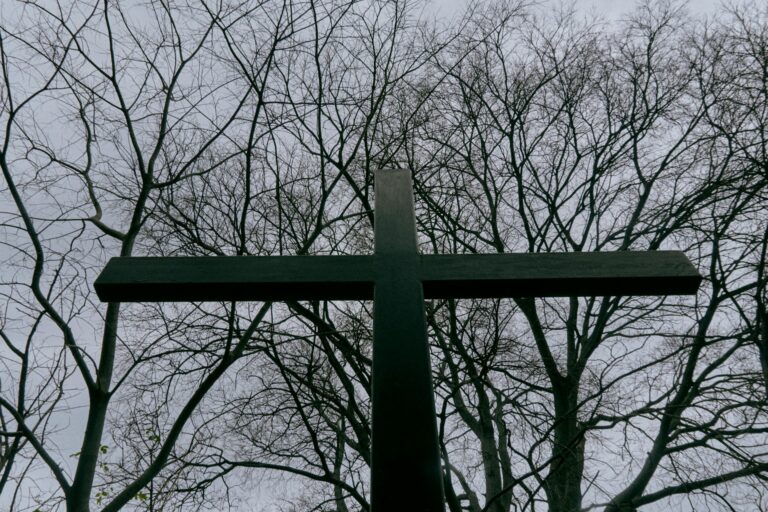
The same Christian tradition that mapped the Trinity onto the triangle also transformed another ancient shape — the cross— from a Roman instrument of execution into the world’s most recognized sacred symbol.
Jewish tradition carries a parallel but distinct weight: the equilateral triangle functioned as a symbol for God whose name may not be spoken. The shape stood in where language was forbidden — a geometric placeholder for the unutterable.
Celtic tradition offers the triquetra — three interlocking arcs forming an implied triangle at their center. It represented the triple goddess (maiden, mother, crone), the three realms (earth, sea, sky), and later was absorbed into Celtic Christianity as a Trinity emblem. Its defining feature: no beginning, no end. The triangle it implies is eternal precisely because it is never quite drawn.
Norse mythology contains the Valknut — three interlocked triangles associated with Odin, the battlefield dead, and the passage between worlds. Found carved on memorial stones and ship burial markers, its exact meaning remains contested among scholars. What’s clear is that three triangles in combination were considered potent enough to stand at the threshold between life and what follows.
Ancient Mayan tradition offers one of the most unexpected readings. The triangle represented a sun-ray — but simultaneously resembled a burgeoning maize shoot emerging from the earth. The same shape carried both celestial and agricultural meaning: light from above and life from below, making the triangle a double symbol of fertility in both cosmic and earthly registers.
Indigenous American weaving and pottery traditions across many nations use triangular mountain forms to represent the sacred axis between earth and sky — not a human-built pyramid ascending toward heaven, but an acknowledgment of triangles that already exist in the landscape, waiting to be recognized.
In Jewish tradition, the equilateral triangle served as a symbol for God precisely because God’s name could not be spoken — the shape stood in where language was forbidden, a geometric substitute for the unutterable.
Triangle Symbol Meaning in Modern Culture and Branding
As the triangle moved from sacred geometry into broader symbolic currency, its meanings didn’t simplify — they multiplied.
Freemasonry placed the triangle at the center of its visual language — and gave it a philosophical structure few outside the tradition know about. The Masonic triangle carries a specific reading: its base represents Duration, while its two rising sides represent Light and Darkness, meeting at the apex where opposites resolve. The Shining Delta — the luminous triangle marked with the Greek letter Δ — was said to relate to the mouths of the Nile, linking geometric form to the origins of civilization itself. The Eye of Providence — an all-seeing eye within a triangle — appeared in Masonic imagery before migrating to the American dollar bill in 1782. That image alone has generated centuries of conspiracy theory, and the reason is geometric: the triangle looks like it’s directing something. The apex points. The eye watches. The shape creates an unavoidable sense of intention.
Pop culture inherited the triangle’s symbolic weight and ran with it. Pink Floyd’s The Dark Side of the Moon uses a prism-triangle refracting white light into a spectrum — transformation, hidden complexity, the visible becoming multiple. The Deathly Hallows symbol from Harry Potter layers a triangle, circle, and line into an emblem of three supreme magical objects. The triangle works there because audiences feel its weight of power before they understand the lore.
Contemporary branding leans on the triangle for its connotations of precision, ambition, and structural authority. The Louvre Pyramid. Adidas’s mountain-mark. Toblerone’s angular peaks. The pattern holds in the digital economy too: Google Drive’s tricolor triangle and Airbnb’s abstract “Bélo” mark — which resolves into an implied triangular form — both tap the same instinct: a shape that reads as direction, destination, somewhere to go. In an attention economy, the triangle doesn’t just symbolize movement. It performs it.
The Shape That Never Stops Pointing
Maybe the triangle’s power is simpler than any of its interpretations.
It points. In a world of circles that contain and squares that sit still, the triangle is the only shape that insists on a destination. Every culture that encountered it — from the pyramid builders of Egypt to the logo designers of Silicon Valley — asked the same question: where is it pointing?
The answers were different. Gods, fire, the feminine, the cosmos, the unutterable name of the divine, the next product launch. But the question never changed.
That’s not a coincidence of symbolism. That’s geometry doing something language can’t: creating direction without words, meaning without translation, urgency without explanation. Three points. One apex. Somewhere to go.
The triangle was the first shape. It may be the last symbol standing.
🔺Fun Fact:
Did you know? The ancient Pythagoreans considered 10 the most perfect number — and they proved it with a triangle. Arrange ten dots into rows of 1, 2, 3, and 4 and you get a perfect equilateral triangle they called the Tetractys. They believed it encoded the mathematical ratios of musical harmony, the structure of the cosmos, and the nature of the soul — and swore their most binding oaths by it, considering it more sacred than any deity’s name.
FAQ:
What does the triangle symbol mean spiritually?
Spiritually, the triangle represents the union of three forces — most commonly divinity, ascension, or the triadic structure of existence — and appears as a sacred symbol in Christianity, Hinduism, Norse mythology, and esoteric traditions worldwide.
What does an upside-down triangle mean?
A downward-pointing triangle traditionally symbolizes the feminine principle, water, the womb, and receptive energy in alchemical and Hindu traditions; in Christian iconography it has been linked to Christ’s human nature; in modern signage it signals caution or the need to yield.
What does the triangle mean in psychology?
In visual psychology, triangles generate “directed tension” — the brain tracks toward the apex, reading the shape as energy in motion rather than a static form, making upward triangles feel aspirational and downward ones feel unstable or threatening.
Why is the triangle associated with secret societies?
The triangle — specifically the Eye of Providence within a triangle on the U.S. dollar bill — became associated with secret societies because of its documented use in Freemasonic iconography; the shape’s visual sense of directed surveillance amplified those associations over centuries.
What does the triangle represent in different religions?
In Christianity it represents the Holy Trinity; in Judaism it stood as a wordless symbol for the unutterable name of God; in Hinduism it structures the Sri Yantra and encodes purusha and prakriti; in Norse tradition the Valknut marks Odin’s domain over death and transition.
What does the triangle symbol mean in alchemy?
In alchemy, the upward triangle represents fire and the masculine principle, the downward triangle represents water and the feminine principle, and their combination into the Star of David symbolizes the union of opposites and the plane of manifestation.
What does an upward triangle symbolize?
An upward triangle represents fire, masculinity, and ascent toward higher states or ideals.
Are there other numbers or symbols that hold similar symbolic power?
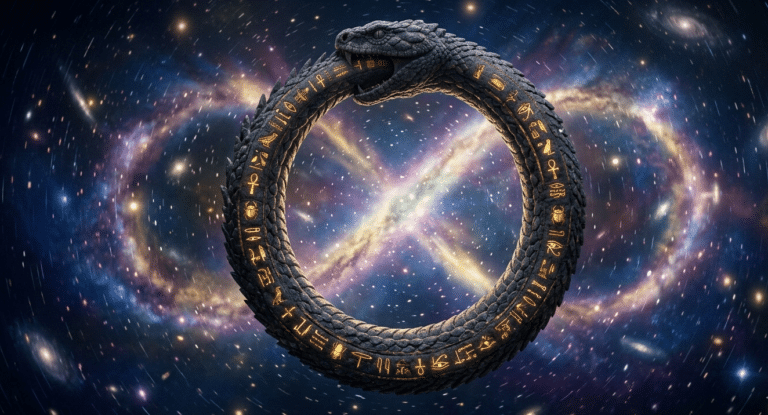
If you enjoyed uncovering the secrets of the Triad, dive into our analysis of The Ouroboros Symbol or discover Why Is the Number 3 So Powerful?
What does the triangle symbol mean in love?
In the context of love, the triangle symbol represents the three essential elements of a lasting relationship: passion, intimacy, and commitment — a framework formalized by psychologist Robert Sternberg in his Triangular Theory of Love (1986). Two interlocking triangles, as in the Star of David, are sometimes used to represent the union of two souls.”
Our complete guide to the 7 most powerful ancient symbols and numbers explores both — alongside five other symbols that ancient civilizations kept returning to, independently, as if they had no choice.