Number 3 Meaning: Why the Human Brain Can’t Resist the Rule of Three
Quick Summary
- The number 3 appears across nearly every major religion, mythology, and cultural system on Earth — not by coincidence, but because of deep cognitive and structural patterns in how humans process the world.
- From the Holy Trinity to the three Fates, the triad carries a universal logic: beginning, middle, end; birth, life, death; past, present, future.
- Modern psychology and neuroscience offer surprising explanations for why our brains are wired to find three-part structures more persuasive, memorable, and satisfying than any other number.
Table of Contents
What is the meaning of number 3?
You already know it before you read a single word.
Three wishes. Three trials. Three brothers. The third time is the charm. The rule of three. In every culture, on every continent, across thousands of years of storytelling, the number three keeps showing up — not randomly, but with an almost aggressive regularity. It’s there in your fairy tales and your religious texts. In your rhetoric and your comedy. In the structure of drama itself.
Why three? Not two, not four, not seven?
The answer cuts through mythology, neuroscience, linguistics, and the deep architecture of human thought. And once you see it, you can’t unsee it. Because three isn’t just a number. It is the minimum structure required for meaning.
Etymology and Origin: Where “Three” Begins
The English word three traces back to the Proto-Indo-European root trei-, one of the most stable and ancient roots in all of linguistics. You can hear its echo in Latin tres, Greek treis, Sanskrit tri, Old Norse þrír, and Russian три. The root survived the fracturing of an entire language family across ten thousand years.
That linguistic persistence is the first clue. The concept of “three” was so fundamental to early human cognition that every branch of Indo-European language preserved it almost identically.
The ancient Sumerians, who built the first known writing system around 3400 BCE, organized their cosmos into three realms: heaven, earth, and the underworld. The Egyptians split divine authority between Osiris, Isis, and Horus — a triad that governed life, death, and resurrection. The Greeks had the three Fates (Moirai), three Graces (Charites), three Furies (Erinyes), and a cosmos divided between Zeus (sky), Poseidon (sea), and Hades (underworld).
These weren’t isolated choices. They were symptoms of something older.
The Proto-Indo-European root *trei- is one of the most preserved roots in linguistic history — evidence that “three” was hardwired into human cognition before recorded civilization began.
The Sacred Triad Across World Religions
No other number appears in sacred texts with the same consistency as three.
In Christianity, the Holy Trinity — Father, Son, and Holy Spirit — defines the nature of God. Jesus rose on the third day. Peter denied him three times. The Magi brought three gifts. Three theological virtues anchor the moral life: Faith, Hope, and Charity.
In Hinduism, the Trimurti unites Brahma (creator), Vishnu (preserver), and Shiva (destroyer). Three functions. One divine cycle. Beneath this sits the doctrine of the three gunas — the three fundamental qualities of all matter and consciousness: tamas (inertia), rajas (activity), and sattva (clarity). The trishula — Shiva’s trident — is one of the most recognizable symbols in the world.
In Buddhism, the Three Jewels (Triratna) — Buddha, Dharma, and Sangha — form the foundation of the entire practice. Taking refuge in these three is the first formal act of becoming a Buddhist.
Taoism offers one of the most elegant formulations of the triad in any tradition. The Tao Te Ching states: “The Tao gives birth to one, one gives birth to two, two gives birth to three, three gives birth to ten thousand things.” The Great Triad — Heaven, Earth, and Humanity — positions the human being not as an observer of the cosmos but as its third, completing force.
Zoroastrianism distilled its entire ethics into three words: Humata, Hukhta, Huvarshta — Good Thoughts, Good Words, Good Deeds. It is arguably the most compressed moral system ever constructed. Three concepts. A whole life.
Kabbalah organizes the ten Sefirot of the Tree of Life around a triadic structure — intellectual, moral, and dynamic — mapping the full spectrum of divine emanation onto three axes of being. Complex system. Triadic skeleton.
Norse mythology gives us three wells beneath Yggdrasil, the world tree. Three Norns weave fate. Odin hung on the world tree for nine days — three times three — to receive the runes.
Celtic tradition was obsessed with triplicities. The triskelion (three spirals) predates written Celtic culture by millennia, carved into the stones of Newgrange in Ireland around 3200 BCE. Celtic goddesses frequently appeared in triple form: the Morrigan as maiden, mother, and crone.
The pattern is global. The pattern is ancient. And it is not accidental.
Alternative Theory: A Cosmic Coincidence — Or Something Deeper?
Some scholars push back on the idea of a universal sacred three.
The diffusionist argument holds that many of these parallels spread through cultural contact — trade routes, conquest, migration. The Silk Road didn’t just carry silk; it carried cosmologies. A triad that started in one tradition could migrate and mutate over centuries until it looked indigenous everywhere.
Others point to structural necessity. Three is simply the smallest number that creates a pattern. Two elements create opposition (good vs. evil, light vs. dark). Three elements create narrative — a beginning, a complication, and a resolution. In this view, the sacred three isn’t mystical. It’s the minimum viable structure for meaning-making.
Then there is Georges Dumézil’s trifunctional hypothesis. Dumézil argued that ancient Indo-European societies organized themselves around three social functions: sovereignty and religion (priests and kings), martial force (warriors), and fertility and production (farmers and craftsmen). He found this division echoed across Hindu, Roman, Norse, and Celtic mythologies — not as spiritual belief, but as the blueprint of society itself. The sacred three, in Dumézil’s reading, wasn’t handed down from heaven. It was built from the ground up. Not a coincidence. A pattern repeating across belief, myth, and society.
There’s also the mnemonic argument: before writing, oral cultures needed patterns that were easy to memorize and transmit. Two-part structures are too simple; four-part structures are too complex. Three sits in the cognitive sweet spot — complex enough to carry meaning, simple enough to remember across generations.
None of these theories fully cancels the others. The truth is probably layered: structural utility, cognitive preference, cultural transmission, and social architecture all feeding the same pattern.
The Psychology and Neuroscience of Three
Psychologists call it the “Rule of Three” — triadic structures are processed faster, remembered longer, and rated as more satisfying than lists of two or four. This isn’t folklore. It’s measurable.
Modern research confirms what ancient storytellers seemed to know instinctively.
Working Memory and the Power of Three
Working memory — the mental scratch pad we use to hold information in the short term — operates most efficiently with chunks of two to four items. Three sits at the center of that range. When information comes in threes, the brain can hold it, process it, and file it without strain.
The Rule of Three in Persuasion
Studies in persuasion psychology consistently show that three-part arguments are more convincing than two-part or four-part ones. This is why politicians, advertisers, and speechwriters reach instinctively for triads: “Life, liberty, and the pursuit of happiness.” “Blood, sweat, and tears.” “Veni, vidi, vici.”
Why the Brain Prefers Triads
The serial position effect — first described by memory researcher Hermann Ebbinghaus in the 1880s — shows that people remember the first and last items in a sequence most reliably. A three-item list maximizes this effect: the first item anchors, the second deepens, the third lands with impact.
Neuroscientist Mark Changizi has argued that the human brain is wired to find certain numerical patterns more aesthetically satisfying, and three consistently triggers what he calls “structural closure” — the satisfying sensation of a completed thought.
The mystical traditions mapped this same logic onto spiritual development. Christian contemplative theology describes three stages of the soul’s journey: purgative (the stripping away of ego), illuminative (the deepening of understanding), and unitive (the final dissolution into the divine). The Sufi path mirrors it. So does the alchemical process — and not by accident. Alchemy’s three primes — sulphur (the active, soul-like principle), mercury (the fluid, spirit-like principle), and salt (the fixed, body-like principle) — map the same triadic logic onto the transformation of matter. Different language. Identical architecture.
Think of every initiation ritual ever recorded: the novice is separated from their old life, suspended in a threshold state, then reborn into the new. Three stages. Always three. The pattern doesn’t just describe the world. It describes change itself.
Three marks completion. The threshold marks entry into it.
Historian of religions Mircea Eliade argued that every sacred space is defined by a threshold — the point where the profane world ends and something larger begins. Three gives that crossing its structure: the stages before, the moment of passage, and what comes after. The number and the doorway are the same idea, expressed in different languages. That’s why we experience beginnings, transitions, and endings not just as events — but as structures.
We explored this architecture in depth — and found it alive and running inside the world’s busiest airports. → The Purgatory of the Terminal
Three is the minimum structure required for meaning. Everything else is elaboration.
Three in Culture: From Ancient Ritual to Modern Storytelling
The triad didn’t stay in temples. It migrated into every form of human expression.
Rhetoric and oratory adopted it so thoroughly that Aristotle formalized it. Classical argument structures — ethos, pathos, logos — run on three pillars. The three-act structure in drama (setup, confrontation, resolution) is so dominant that modern screenwriting software is literally built around it.
Fairy tales weaponize the triad with almost mechanical precision. Three brothers. Three tasks. Three chances. Vladimir Propp, the Russian folklorist who analyzed hundreds of fairy tales in the 1920s, found triadic repetition to be one of the most consistent structural elements across European folklore. The hero always fails twice before succeeding on the third attempt. The pattern builds tension, teaches persistence, and rewards patience — all encoded in a number.
Comedy discovered the triad independently. The “rule of three” in joke construction — setup, reinforcement, subversion — is a structural law. The third beat is where the punchline lives. Ask any comedian.
Music runs on threes: the waltz, the triad chord (the foundation of Western harmony), triple meter, the three-verse structure of folk songs.
Even architecture loves three. Greek temples feature three architectural orders. The triumphal arch frames its central passage with two flanking archways. The Eiffel Tower’s silhouette reads as three vertical sections. The eye seeks the triad because the brain does.
How Different Cultures Read the Triad
The meanings shift. The structure doesn’t.
In Chinese culture, three (三, sān) is broadly positive — it sounds like the word for “life” (生) in some dialects and appears in auspicious phrases. But its significance is more contextual than absolute; Chinese numerology gives far more weight to eight and four.
In Japanese tradition, sets of three appear in art (wabi, sabi, shibui — three aesthetic principles), in religion (the Three Treasures of Buddhism), and in the imperial regalia (three sacred objects). The triangular composition is a cornerstone of Japanese visual art.
Islamic tradition holds that odd numbers, particularly three, carry special blessing. The Prophet Muhammad reportedly favored odd numbers in ritual practice, and three specifically appears across hadith as a number of completion.
In African Yoruba cosmology, the sacred number three reflects the structure of Orun (heaven), Aiye (earth), and the transitional realm between them — a triadic universe that parallels Sumerian and Greek models independently.
Celtic knotwork frequently returns to triple forms. The triquetra — three interlocked arcs with no beginning or end — became one of the most enduring symbols of Celtic identity, later adopted into Christian iconography as a representation of the Trinity.
Across all of these traditions, no culture looked at three and saw chaos. Every culture looked at three and saw order.
Fun Fact
Did You Know? The ancient Pythagoreans considered three the first true number — because it was the first to have a beginning, a middle, and an end. They called it arithmos teleios: the perfect number. One was a point. Two was a line. Three was the first shape — a triangle — and therefore the first thing in the universe that actually existed in space.
Engineers know why: the triangle is the only geometric shape that cannot be deformed without changing the length of its sides. It is, structurally, the most stable form in existence. The “completeness” three makes us feel isn’t just psychological. It’s physical.
FAQ
Why is the number 3 considered sacred?
The number 3 is considered sacred because it appears across many religions and mythologies as a symbol of completeness and divine order. It often represents cycles like birth, life, and death or structures like beginning, middle, and end.
What is the symbolism of the number 3?
The number 3 symbolizes balance, completeness, and structure. It commonly represents patterns like past, present, future or body, mind, spirit, making it one of the most universal symbolic numbers.
Why do humans prefer things in threes?
Humans prefer things in threes because the brain processes and remembers three-part structures more easily. This makes them more satisfying, persuasive, and easier to recall than longer or shorter patterns.
What religions use the sacred triad?
Many religions use triads, including Christianity (Trinity), Hinduism (Trimurti), and Buddhism (Three Jewels). These systems use three-part structures to explain divine order and the nature of reality.
Is the rule of three a myth or a real principle?
The rule of three is both a cultural pattern and a real psychological principle. Research shows that three-part structures are easier to process, remember, and find satisfying.
Where does the phrase “third time’s a charm” come from?
The phrase comes from medieval folklore and magic traditions, where three attempts were believed necessary to complete a spell or achieve success.
Are there other numbers or symbols that hold similar symbolic power?
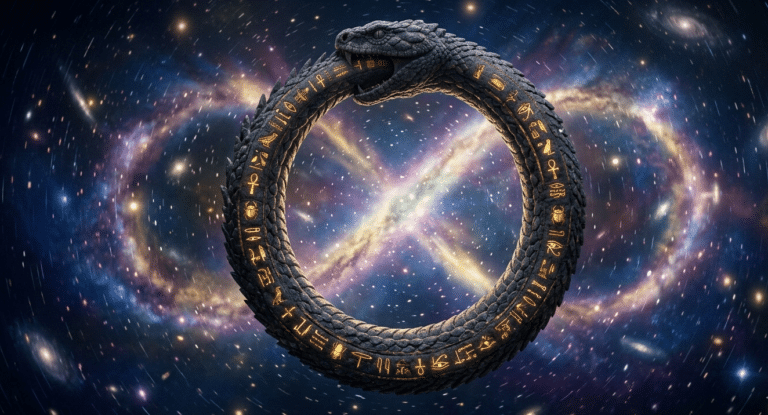
If you enjoyed uncovering the secrets of the Triad, dive into our analysis of The Ouroboros Symbol or discover Why Is the Number 13 Unlucky?
If the number three pulled you in, our complete guide to the 7 most powerful ancient symbols and numbers shows how it fits into a much larger pattern — one that stretched across every civilization that ever tried to make sense of the world.