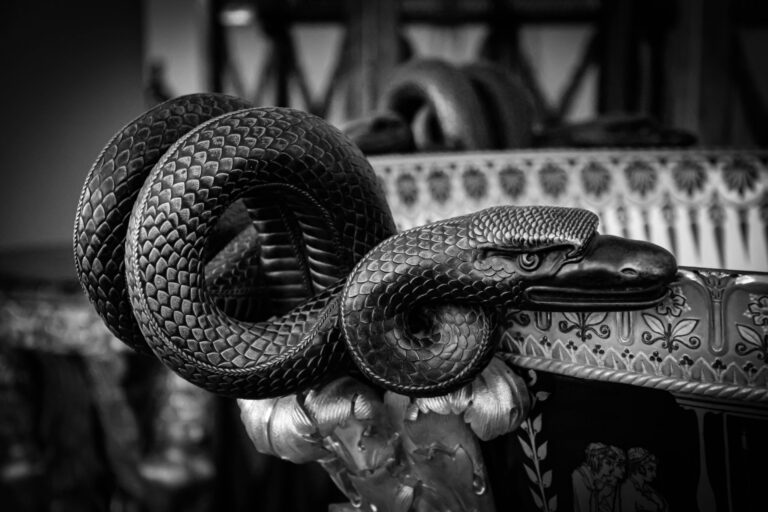
Ouroboros Symbol Meaning: The Snake Eating Its Own Tail Explained
Quick Summary:
- The earliest known ouroboros origin dates back to ancient Egypt around 1600 BCE, where it symbolized the eternal cycle of time and the unity of beginnings and endings.
- Across cultures — including Norse, Hindu, and Gnostic traditions — ouroboros symbolism reflects the idea that existence is continuous and self-sustaining.
- In psychology, Carl Jung interpreted the ouroboros as a symbol of individuation and inner transformation.
- In science, the ouroboros meaning appears in concepts like recursion and the cyclic structure of molecules such as benzene.
What is the Ouroboros symbol?
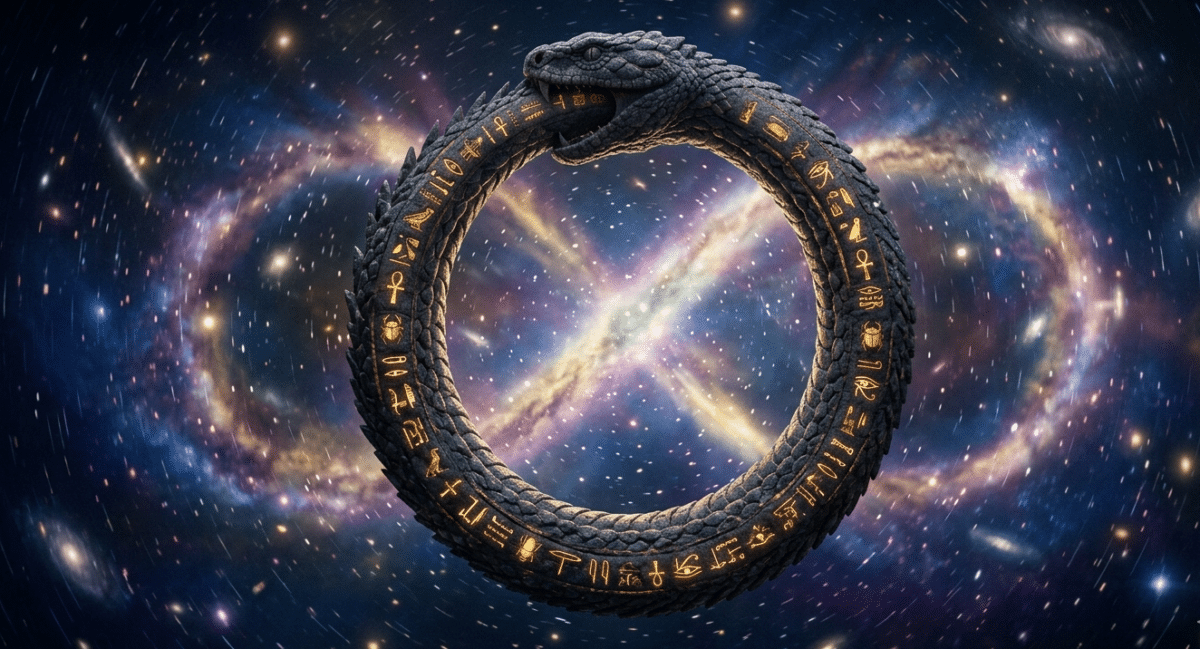
The ouroboros is an ancient symbol of a serpent eating its own tail, representing the eternal cycle of life, death, and renewal. First appearing in ancient Egypt, it has been used across cultures to express the idea that beginnings and endings are inseparable.
Table of Contents
The Meaning of the Ouroboros Symbol
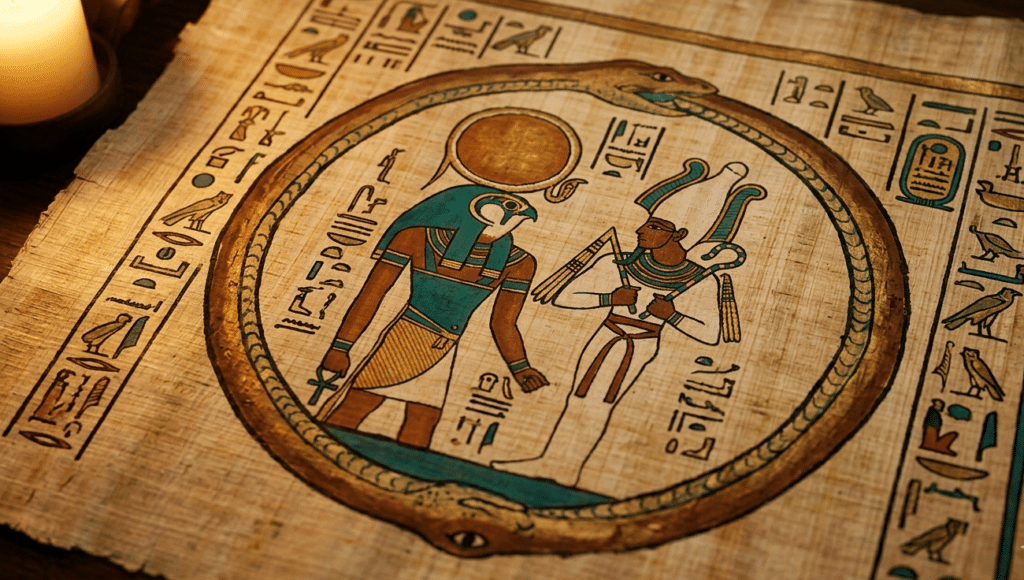
Picture an Egyptian tomb, 1600 BCE. The walls are covered in spells and star maps — everything the dead might need for what comes next. And there, coiled in the margins of the oldest known version of the Book of the Dead, a serpent bends back on itself and eats its own tail.
No caption needed. The image carries its own argument. Something is ending. Something is beginning. They are the same moment.
That image is the ouroboros symbol — one of the oldest representations of cyclical time and self-renewal. And it never really stopped circulating.
The Origin of the Ouroboros: Where Does It Come From?
The word ouroboros comes from ancient Greek: oura (οὐρά), meaning tail, and boros (βόρος), from biberoskein — to eat, to devour. The tail-devourer. A name that is also a complete description.
Its earliest confirmed appearance comes from the Enigmatic Book of the Netherworld, found in the tomb of Tutankhamun. Egyptian priests used it to represent the sun god Ra merging with Osiris — the moment night and dawn become indistinguishable, the exact second the cycle renews itself.
From Egypt, the symbol traveled east and west simultaneously. The Phoenicians carried it into Greek mystery schools. Gnostic texts from the 2nd century CE used it to represent the boundary of the universe — a serpent so large it wrapped around all of existence, containing everything inside its body.
“The beginning and the end are the same” — not a philosophical abstraction, but a visual proof coiled in the margins of a death manual.
The Ouroboros Across Mythology
Parallel traditions suggest the idea may not have traveled from Egypt outward — it may have emerged independently, several times over.
Jörmungandr: The Norse World Serpent
In Norse mythology, Jörmungandr, the Midgard Serpent, wraps around the entire world and bites its own tail. Norse cosmology frames this not as peace but as tension: the moment Jörmungandr releases its tail, Ragnarök begins. Here the ouroboros is less a symbol of harmony and more a locked mechanism — the world held together by a serpent choosing, perpetually, not to let go.
Shesha and Ananta: The Infinite Serpent in Hindu Cosmology
In Hindu iconography, Shesha (also called Ananta — “the infinite”) coils beneath the sleeping Vishnu, its multiple heads fanning out like a canopy above him. The serpent doesn’t just represent eternity; it is the substrate on which reality rests between cycles of creation.
Whether these traditions borrowed from a common source or arrived independently remains genuinely contested among mythologists. The folkloric reading — that humans across continents independently concluded that snakes look like forever — is at least as plausible as any single origin theory.
The Ouroboros in Psychology and Science
Carl Jung and the ouroboros archetype
Carl Jung didn’t just notice the ouroboros — he made it foundational to his theory of the collective unconscious. In his 1944 work Psychology and Alchemy, he described it as the most archaic symbol of individuation: the self consuming and recreating itself. The snake eating its tail became his image for the psyche’s need to process, destroy, and integrate its own contents.
The cognitive pull is real. Humans are pattern-detection machines with a strong bias toward cycles — day/night, sleep/waking, birth/death. A symbol that visualizes an endless loop activates something deep in the brain’s predictive architecture. Researchers in embodied cognition suggest that circular forms are processed as inherently stable, which may explain why the ouroboros feels not just visually satisfying but true in a way that’s hard to articulate.
Kekulé’s dream and the benzene ring
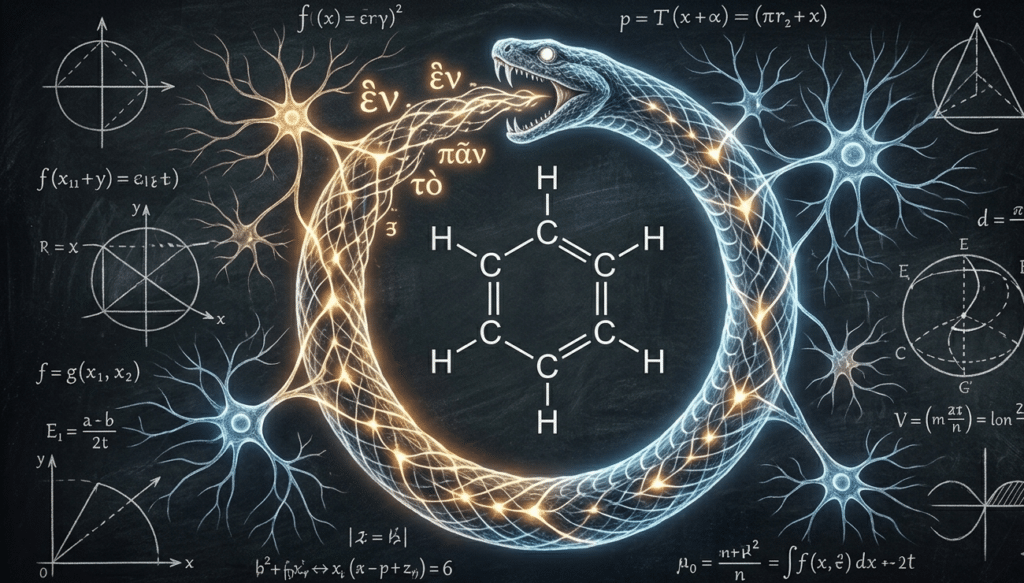
In 1865, the German chemist August Kekulé claimed he discovered the ring structure of benzene after dreaming of a snake biting its own tail. Whether the anecdote is historically accurate is debated — but the story became canonical in scientific culture, a myth about how the ouroboros literally unlocked modern organic chemistry.
The Ouroboros in Alchemy, Philosophy and Modern Culture
Alchemists adopted it in medieval Europe as the prime symbol of the philosopher’s stone — the substance that could transmute base metal into gold and, more importantly, death into life. The phrase en to pan (ἓν τὸ πᾶν — “all is one”) often appeared inscribed around the serpent’s body.
The symbol showed up in Freemasonry, Hermeticism, Rosicrucianism. It migrated into the occult revival of the 19th century. By the 20th, it had crossed into popular culture so thoroughly that most people recognize the image without knowing its name.
In programming, a function that calls itself is recursive — and some developers deliberately use the ouroboros to represent recursion in technical documentation. The image works because it is recursive: a form that contains itself, that produces itself, that cannot be separated from the act of its own generation.
The Evolution of the Ouroboros Symbol
How different civilizations interpreted the ouroboros symbol
| Culture | Meaning |
| Ancient Egypt | Solar cycle; Ra-Osiris merger; guardian of the underworld’s boundary |
| Norse | Jörmungandr holding Ragnarök at bay — existence as tension, not harmony |
| Hindu | Shesha/Ananta — the infinite serpent as the ground of cosmic sleep |
| Gnostic | Boundary of the universe; the limit where inside and outside dissolve |
| Medieval Alchemy | “All is one” — the cyclic transmutation of matter and death into life |
| Modern | Recursion, infinity loops, self-reference in mathematics and code |
Why the Ouroboros Still Matters Today
The ouroboros didn’t survive four thousand years because people kept choosing to preserve it. It survived because it kept becoming useful again.
Every era that encountered it found a different problem it could solve. Egyptian priests needed an image for a cycle that had no outside. Gnostics needed a boundary for a universe that had no edge. Alchemists needed a symbol for a transformation that consumed its own starting material. Jung needed a name for a psyche that grows by destroying its earlier versions of itself.
None of them borrowed the symbol because it was ancient. They borrowed it because it was accurate.
That pattern hasn’t stopped. When programmers reached for a way to illustrate recursion — a function that calls itself, producing output from its own input — they didn’t invent a new image. The ouroboros was already there, already doing the job. When physicists began describing quantum field interactions where particles briefly couple with themselves, the symbol surfaced again in the margins of lectures and textbooks. Not as decoration. As the clearest available shorthand.
What the ouroboros encodes is something that remains genuinely difficult to say in words: that some processes don’t have a first cause, that some systems are their own origin, that beginning and end are not always two points on a line but sometimes the same point on a loop.
That idea was strange in 1600 BCE. It is still strange now. The symbol endures because the strangeness does.
Fun Fact
Did you know? The ouroboros appears in the margin of the oldest surviving copy of the Book of the Dead — but the full circle form with the serpent’s tail cleanly in its mouth only stabilized in Greek alchemical manuscripts centuries later. The Egyptian original shows the serpent bent into a rough oval with its head meeting its tail but not quite closing. The perfect circle came later, added by cultures who decided the symbol needed to be more exact than the idea itself required.
FAQ
What does the ouroboros symbol mean?
The ouroboros symbol represents infinity, cyclicality, and self-renewal. Its core meaning is that endings and beginnings are part of the same continuous process.
Where did the ouroboros originate?
The ouroboros origin dates back to ancient Egypt, where it appeared in funerary texts around 1600 BCE as a symbol of eternal cycles and cosmic renewal.
What is the ouroboros in psychology?
In psychology, Carl Jung interpreted the ouroboros as a symbol of individuation — the process through which the self continually transforms and integrates its own experiences.
Is the ouroboros a religious symbol?
It appears in religious, alchemical, and philosophical traditions across cultures, but it is not exclusive to any single religion — it functions more as a universal symbol of cyclical existence.
What is the difference between the ouroboros and the infinity symbol?
The infinity symbol (∞) is a mathematical abstraction formalized in the 17th century; the ouroboros is an ancient mythological image. Both represent endless continuity, but the ouroboros carries deeper symbolic and cultural meaning.
What does ouroboros mean as a tattoo?
Most people who choose the ouroboros as a tattoo intend it to represent personal transformation, the acceptance of life’s cyclical nature, or the idea that all things return to their origin.
Is the ouroboros a real snake?
No, the ouroboros is a symbolic image, not a real snake. It represents abstract ideas like infinity, cycles, and self-contained systems.
Why is the ouroboros important?
The ouroboros is important because it represents a fundamental idea found in many fields — that some systems are cyclical and self-sustaining. This makes it relevant not only in mythology, but also in psychology, science, and philosophy.
Are there other numbers or symbols that hold similar symbolic power?
If you enjoyed uncovering the secrets of the Triad, dive into our analysis of Tringle Symbol or discover why is the number 13 unlucky?
Our complete guide to the 7 most powerful ancient symbols and numbers brings all seven together in one place, for anyone who wants to see the full picture.