The Cross Symbol: How an Instrument of Shame Became the World’s Most Powerful Icon
Quick Summary
- The cross predates Christianity by millennia — appearing in Egypt, Mesopotamia, China, and Mesoamerica as a cosmic symbol long before the Crucifixion.
- Romans engineered crucifixion to destroy not just the body but the social identity of the condemned — the cross was a machine of public shame.
- Christian theology reframed the cross as the new World Tree (axis mundi), replacing the Tree of Knowledge with a cosmic pillar connecting earth, heaven, and the underworld — a move scholars trace directly to pre-Christian mythology.
Table of Contents
A Shape That Shouldn’t Mean Hope
Picture a street corner in Rome, 50 CE. A man hangs from two crossed beams outside the city gates. His hands are pinned. Passersby avert their eyes — not from horror, but from social obligation. To look too long is to acknowledge the condemned. To acknowledge him is to associate with his shame.
That is what the cross meant. Not sacrifice. Not redemption. Disgrace.
The Roman orator Cicero called crucifixion “the most cruel and horrifying death.” Jewish tradition held that a man hanged on a tree was cursed by God. Everyone in the ancient Mediterranean world — Roman, Greek, Jewish, Egyptian — understood the cross as a symbol of the absolute bottom of the social order.
Which makes what happened next one of the most remarkable symbolic reversals ever recorded. Within three centuries, that same shape adorned the helmets of Roman soldiers, the walls of basilicas, and the crowns of emperors. It became — and remains — the most recognized symbol on earth. The question is not just how. It is why this shape, in particular.
Etymology: The Word Carved in Wood
The English word cross derives from the Latin crux — meaning simply “stake” or “pole.” It entered Old English via Old Irish cros, carried westward by the Roman Empire’s linguistic reach.
Crux also gave us the modern phrase “the crux of the matter” — the critical, agonizing point. The word carried its original weight into metaphor. Even now, when something is at a crossroads, the language echoes the gallows.
In Greek, the instrument was called stauros (σταυρός), originally meaning an upright stake. Early Christian texts used this term before the Latin took hold in the West. The visual symbol — the familiar two-beamed cross — did not become the standard Christian icon until the 4th century CE. For the first 300 years, followers avoided depicting it entirely. Instead they used the fish (ichthys), the Chi-Rho monogram (the first two letters of Christos in Greek), and the anchor — signs legible only to insiders. The cross was still too raw. Too recognizable as an instrument of execution. The wound was fresh.
The cross didn’t become a mainstream Christian symbol until roughly 300 years after the Crucifixion. The earliest believers actively avoided it — because to a Roman or Jewish audience, displaying a cross was equivalent to displaying a noose.
Before the Crucifixion: The Cross as Cosmic Geometry
Here is what complicates the story. The cross, as a shape, is ancient. Far older than Rome. Older than Christianity. Arguably older than writing itself.
In ancient Mesopotamia, the sun god Shamash was depicted within a cross-shaped disc. The Indus Valley civilization used cross motifs on ceremonial pottery around 2500 BCE. Solar crosses — four equal arms within a circle — appear on Bronze Age rock carvings across Scandinavia and the Alps, marking the turning points of the seasonal year. Evidence of cross symbols surfaces in China and Crete as far back as the 15th century BCE, in cultures with no documented contact with one another. Egypt alone produced dozens of cross variants — but that story belongs to the next section.
Why does the cross emerge everywhere, independently? Start with the geometry. Two lines intersecting at a center point produce something that feels immediately meaningful — because it is immediately meaningful. The vertical line reaches up and down: toward heaven, toward earth, toward the underworld. It represents the celestial, the spirit, the active principle. The horizontal line reaches left and right: across the human plane, through the material world, the passive and the earthly. Where they cross, something precise happens. The two dimensions of existence meet at a single point. That point is the self. That point is the cosmos. That point is, in every tradition that has ever grappled with it, sacred.
The vertical arm of the cross reaches toward heaven and the underworld — spirit, the active, the divine. The horizontal arm spans the human plane — matter, the passive, the earthly. Their intersection is not an accident of carpentry. It is a map of existence.
Carl Jung identified the cross as one of his core archetypes — a symbol rising from the collective unconscious because it mirrors the fundamental structure of being a body in space. Anthropologist Mircea Eliade, in The Sacred and the Profane(1957), went further: the vertical axis of the cross — the axis mundi, the World Axis — represents a near-universal human intuition of a cosmic center connecting heaven, earth, and the underworld. Ladders, mountains, sacred pillars, great trees — across cultures, humans reached for the same image to describe the same thing. The cross belongs to that family. For Eliade, it was not invented. It was recognized.
But there is a more specific connection — one that goes beyond geometry into theology. In Christian thought, the Cross and the ancient image of the World Tree (or Cosmic Tree) are not merely analogous. They are, according to a significant strand of patristic and medieval interpretation, the same symbol.
The World Tree — a great axis rising from the depths of the earth through the human plane into the highest heavens — appears across Norse mythology (Yggdrasil), Vedic tradition, Siberian shamanism, and countless other systems. It connects the three realms. It sustains the universe. It is the bond of all things. Byzantine hymns explicitly describe the Cross in identical terms: a tree “rising from the earth to the heavens,” the “immortal plant,” the “bond of all things,” sanctifying the entire cosmos from its roots to its crown.
The theologian Henri de Lubac argued that this identification — Cross as World Tree — reveals something essential about how Christianity operated: it did not abolish the symbolic vocabulary of the ancient world. It elevated it, redirecting its accumulated power toward a new center. The Cross, in this reading, becomes the supreme axis mundi: the pole around which the cosmos turns, the channel through which heaven and earth communicate.
The Wood of Eden
There is a stranger version of this story — one that circulated in medieval Christianity as legend rather than doctrine, but whose persistence reveals how deep the World Tree connection ran.
According to this tradition, the True Cross was not simply any timber. It was fashioned from the wood of the Tree of Life that stood at the center of the Garden of Eden. One variant holds that a branch of that tree was planted on Adam’s grave on Golgotha — the very hill where the Crucifixion later took place. The wood grew. Centuries passed. The tree was felled and shaped into the beams of the Cross.
In this legend, the geography of salvation becomes impossibly precise: the tree that stood at the center of creation, the grave of the first man, and the execution of the one Christians call the last Adam — all at the same coordinates. The Cross does not merely replace the Tree of Knowledge of Good and Evil. It grows from the same root. It closes the circle that the first sin opened.
There is no historical evidence for this legend. But its persistence — it appears in the Golden Legend, one of the most widely read books of medieval Europe — tells us something true about how the symbol functioned in the popular imagination. The Cross needed to be cosmic. A Roman execution device was not enough. It had to reach back to the beginning of things.
The Trees Before the Cross
The Eden legend operated inside Christian theology. But there was another absorption happening simultaneously — one that unfolded not in texts but on the ground, across the forests and hilltops of pre-Christian Northern Europe.
For Germanic tribes, the Irminsul was not a metaphor. It was a physical structure — a great wooden pillar or living tree, standing at the center of sacred space, understood as the axis holding heaven and earth apart. Norse cosmology organized the entire universe around Yggdrasil, the World Ash, whose roots reached into the realm of the dead and whose branches brushed the halls of the gods. Celtic druids conducted their most important rituals in oak groves — the tree was the temple, the canopy its ceiling, the roots its foundation reaching into the underworld. For these cultures, the sacred tree was not a symbol of the cosmic axis. It was the cosmic axis. You could touch it. Stand beneath it. Bring your dead to it.
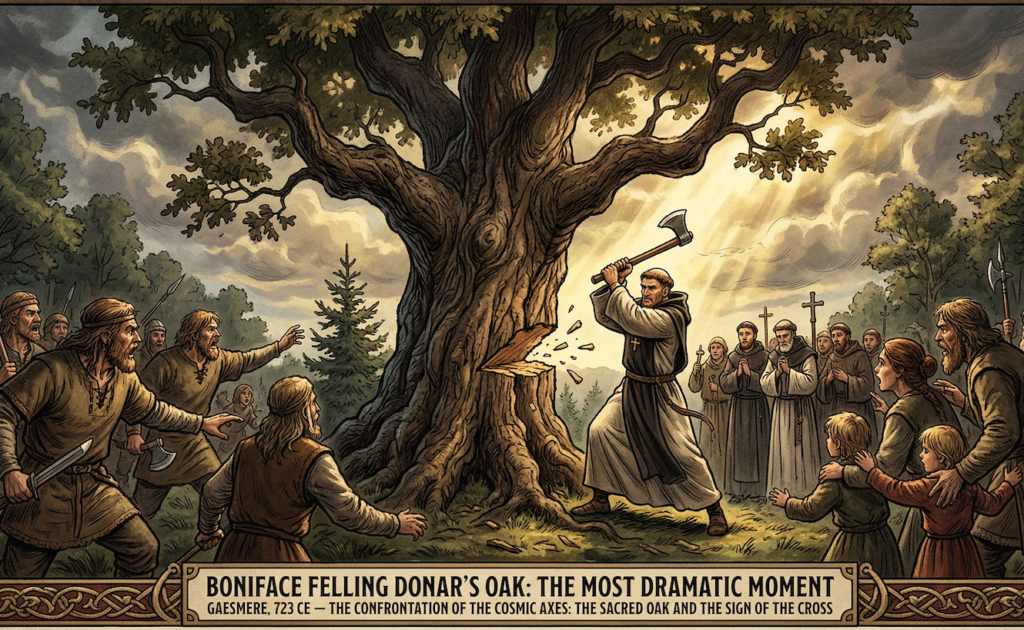
Christianity arrived into this world with a complicated relationship to those trees. The official posture was demolition. In 723 CE, the English missionary Boniface took an axe to Donar’s Oak — the sacred Germanic tree dedicated to the thunder god — at Geismar, in what is now central Germany. It was a deliberate provocation, a public proof that the pagan tree held no divine power. The local population watched, waiting for Boniface to be struck down. He was not. He survived. And then, with the timber from that felled oak, he built a chapel.
The gesture was more than tactical. It was structural. The sacred space did not move — it was overwritten. The axis remained at Geismar. Only the theology changed.
Christianity did not always destroy pagan sacred trees. More often it planted crosses beside them, built churches on top of them, and inherited their accumulated sacredness without formally acknowledging the debt. The vertical axis remained. Only the theology changed.
This pattern repeated itself across the Christianization of Northern Europe. Missionaries did not always destroy sacred trees outright. More often they planted crosses beside them, consecrated the ground around them, built churches on top of the sites. The vertical pole remained. The cross simply replaced it at the center of that vertical axis — inheriting centuries of accumulated sacredness without formally acknowledging the debt.
When Scandinavian converts heard the story of Christ dying on a wooden cross and descending into the underworld, some of them would have recognized the shape of another story. In Norse mythology, Odin hangs from Yggdrasil for nine days and nine nights — pierced by his own spear, without food or water, sacrificing himself to himself in order to receive the wisdom of the runes from the depths below. He descends into knowledge through suffering. He returns transformed. The structural parallel with the Crucifixion is precise enough that scholars have long debated the direction of influence: did the Odin myth absorb Christian imagery, or did missionaries consciously frame the Crucifixion in terms that Norse converts would already recognize? Most likely both happened simultaneously, at different places, by different people, for different reasons.
This same mechanism — pagan ritual reframed in Christian terms, kept alive by the new theology — surfaces in gestures that survive to this day. When someone crosses their fingers, they are performing a gesture whose roots reach back to a pre-Christian belief that evil spirits traveled in straight lines and became trapped at a crossing point. Two fingers locked at a junction created a protective threshold — a miniature cross held in the hand. The Christian era layered new meaning onto the gesture: crossed fingers invoked the Holy Cross, anchoring a wish or a vow to divine witness.
The same logic governed the act of touching wood — a ritual that would eventually evolve into the superstition we now call knocking on wood. Across Celtic and Germanic traditions, certain trees — oak above all — were believed to house protective spirits that could be reached through physical contact. To press your palm against the bark was not a superstition. It was a transaction: human need meeting divine presence at the surface of the wood. When Christianity spread, the ritual was not abandoned. It was baptized. The devout came to believe that by touching a wooden surface they were making contact with the True Cross itself — the timber of Golgotha, the most sacred wood in existence. The pagan hand reaching for the spirit in the oak became the Christian hand reaching for the wood of salvation. The gesture survived intact. The theology around it simply changed address.
The most durable symbols don’t survive in stone and gold — they survive in the small, unconscious movements of human hands.
The Roman Machinery of Shame
To understand the transformation, you have to understand what crucifixion was actually designed to do.
It was not primarily a method of execution. Death by crucifixion was slow — sometimes taking days. It was a method of communication. The Jewish historian Josephus, writing in the 1st century CE, described mass crucifixions outside Jerusalem during the Roman siege — soldiers nailing prisoners to crosses in different positions, “out of rage and hatred,” until there was no more room for crosses and no more crosses for bodies. The image he leaves is not of death. It is of a landscape of shame, engineered at industrial scale.
Romans placed crosses at roadsides, city gates, public squares — the most visible locations possible. The message was political. This is what happens to rebels. To thieves. To those who defy Rome. Seneca, writing around 50 CE, noted that crucified men were positioned to face the crowd — the direction of death was chosen for maximum audience. The condemned did not die facing the sky. They died facing the people they were meant to warn.
The process stripped the condemned of every marker of humanity. Victims were naked. They were denied burial — bodies left to decay publicly, cutting the dead off from the rites that, in the ancient world, guaranteed dignity in the afterlife. In Jewish theology, a crucified man was not merely disgraced socially. He was cut off from God.
This is the context in which the earliest Christians operated. When Paul wrote to the Corinthians around 54 CE, he acknowledged it directly: the cross was “a stumbling block to Jews and foolishness to Gentiles.” He was not being metaphorical. He was describing the lived experience of trying to tell a Roman or Jewish audience that your executed founder — killed as a criminal, on the lowest possible instrument of death — was the Son of God.
The theologian Martin Hengel, in his 1977 study Crucifixion, documented in exhaustive detail just how culturally toxic the cross was to ancient audiences. His conclusion: there is no parallel in any other religion for taking the instrument of a founder’s public execution and making it the central symbol of faith. It was an act of radical symbolic reversal with no historical precedent.
The Psychological Pivot: Why Shame Became Sacred
How does a torture device become an object of veneration? The psychology is complex — and genuinely contested.
Nietzsche offered the darkest reading. In The Genealogy of Morality (1887), he called the Christian revaluation of the cross a masterwork of ressentiment — the oppressed inverting the values of their oppressors, declaring weakness strength and suffering glory. For Nietzsche, it was psychological survival strategy, not spiritual truth. The cross was not elevated because it was beautiful. It was elevated because the people who carried it had no other weapon.
Modern social psychology offers a more structural reading. Research on stigma transformation — the process by which marked or shameful objects become identity symbols — shows this is a recognizable pattern. Groups facing persecution frequently adopt the symbols of their persecution as badges of solidarity. The pink triangle, originally a Nazi concentration camp marker for gay men, was reclaimed by LGBTQ+ activists in the 1970s as a symbol of resistance. The dynamic is structurally identical: take the wound, make it a weapon.
For early Christians, the cross became coherent within a specific theological frame: if the resurrection was real, then the shame of the cross was not the final word. The cross became the hinge of history — the low point before the reversal. Its ugliness was not erased but redeemed. A sanitized symbol would have lost the charge. The cross works because it carries the memory of what it cost.
The World Tree framework added another layer. Just as the shamanic World Tree allowed its climber to descend into the underworld and return, Christian theology described the Crucifixion as a deliberate descent — Christ entering death to rescue what was lost. Scholars have noted the structural parallel with the myth of Orpheus, and with shamanic motifs found across Siberian and Central Asian traditions. The Cross-as-Tree did not merely represent suffering. It represented the journey through suffering and back.
Psychologists call this stigma transformation — oppressed groups reclaiming the symbols of their persecution as identity markers. The cross is the oldest and most dramatic example in recorded history. But its theological depth went further: by mapping onto World Tree mythology, it offered not just solidarity but a cosmic narrative of descent and return.
Constantine and the Political Cross
Not everyone reads the cross’s transformation as purely spiritual. There is a hard political argument — and it begins with a man whose behavior does not fit the profile of a sincere convert.
In 312 CE, the Roman Emperor Constantine reportedly saw a vision — a cross of light in the sky — before the Battle of Milvian Bridge. He won. He converted. Within a generation, the cross went from the mark of Rome’s lowest criminals to the emblem on Rome’s military standards. The story, as Constantine told it, was one of divine revelation and genuine faith.
The biography tells a different story. In 326 CE — fourteen years after his conversion, at the height of his Christian empire — Constantine ordered the execution of his own son Crispus, a celebrated military commander, on charges that were never made public. Within weeks, he had his wife Fausta killed as well, suffocated in an overheated bath. His mother Helena, newly returned from a pilgrimage to Jerusalem where she claimed to have discovered the True Cross, reportedly intervened too late. The man who placed the cross on Roman military standards also eliminated his own family with the efficiency of a general clearing a battlefield. No contemporary Christian chronicler could satisfactorily explain it.
This is the Constantine that Gibbon found so difficult to sanctify. In The Decline and Fall of the Roman Empire, he catalogued the emperor’s violence with barely concealed skepticism, concluding that Constantine’s Christianity was inseparable from his politics. Modern historians like Peter Weiss have argued that the famous vision account — elaborated over decades, growing more miraculous with each retelling — bears the marks of deliberate myth-making. A fractured empire needed a unifying story. The cross, reframed as a symbol of divine imperial authority rather than criminal shame, provided one. His reported words before the battle, in hoc signo vinces (“in this sign, conquer”), collapsed the distance between sacred symbol and military command. A sign that had once marked the condemned was now ordering armies forward.
Whether Constantine believed or calculated — and the answer was probably both, in proportions that shifted across a long and violent reign — his use of the cross changed history. He did not create the symbol’s power. He borrowed it, scaled it, and attached it to the machinery of empire. The cross survived Constantine too. But it came out the other side carrying something it had not carried before: the weight of a throne.
The Cross Across Cultures: One Shape, Many Worlds

The cross did not spread from Rome outward. It was already everywhere. What Rome did was charge it — electrify a shape that already lived in the visual vocabulary of nearly every civilization on earth.
The Egyptian ankh gave the cross its loop — the sign of life held in the hands of gods and pharaohs alike. In ancient Hebrew tradition, the Tau cross — the last letter of the alphabet, shaped like a T — marked the foreheads of the righteous in the Book of Ezekiel, a sign of divine protection inscribed before judgment. For the Aztec and Maya, the four-armed cross was a literal map of the cosmos, north-south-east-west, with the self at its sacred center. In Bantu cosmology, crossroads are thresholds — the precise point where two paths intersect creates a center of the world. The Bakongo people of Central Africa encoded this belief in the cosmogram: a circle bisected by a cross, each arm representing a stage of the soul’s journey between the living and the dead. To draw that cross on the ground was to open a channel. To stand at a crossroads was to stand at the boundary between worlds.
Celtic Christianity fused the Latin cross with a ring — possibly absorbing pre-Christian sun symbolism, possibly just solving a structural engineering problem in carved stone. Scholars still argue. The ambiguity is the point. In Ethiopian Orthodoxy, the cross is not a sign but a presence: ornate, latticed, dressed in cloth, carried through crowds in procession. It receives reverence the way a living thing does. In Rosicrucian esoteric tradition, a rose blooms at the center of the cross — the junction of spirit and matter — representing the soul’s alchemical work of becoming: the rose unfolding at the precise point where heaven and earth meet.
What all of these share is not doctrine. It is structure. The cross marks a threshold — the meeting point of opposites, the place where realms touch, the coordinates where the self locates itself in the cosmos. The specific theology changes. The underlying geometry does not.
Modern Life: Sacred, Aesthetic, Contested
The cross never left secular space. It simply changed its language.
Stand in the middle of Washington D.C. and look at the city’s plan. The Mall extends east to west; the axis from the Capitol to the Lincoln Memorial runs perpendicular. The city’s foundational geometry is cruciform — not accidentally. Pierre Charles L’Enfant, the French engineer who designed it, worked in a tradition of urban planning that treated the cross-shaped city plan as a statement of order, authority, and cosmic alignment. Bernini’s colonnade at St. Peter’s Square performs the same move: an ellipse bisected by a cross axis, the obelisk at its center functioning as a literal axis mundi, the pole around which the sacred space turns. Secular power and sacred power both reach for the same geometry. The cross is, at its most basic, the shape that authority takes when it wants to claim the center.
Popular culture borrows the same authority — but with the volume turned up. Madonna built a career on the friction between sacred and provocative, using cross imagery to generate exactly the tension that friction produces. The provocation only works because the symbol is still sacred. You cannot desecrate something that has already lost its charge. When she wore a crown of thorns on the Confessions tour, she was not dismissing Christianity — she was feeding off it. Kanye West moves differently. His Yeezus album and the Christ-pose performances that followed were not ironic. He was not maintaining distance. He wanted the symbol fully, as identity, as claim. Where Madonna used the cross as a weapon against the sacred, Kanye used it as a gate into the sacred — a different kind of appropriation, and in some ways a stranger one.
The KKK’s burning cross represents the darkest version of this borrowing. Adopted from a fictional scene in D.W. Griffith’s The Birth of a Nation (1915) — with no basis in actual Reconstruction-era practice — the burning cross weaponized the symbol’s sacred associations to amplify terror rather than comfort. It is the most cynical deployment of the cross’s symbolic power: using the axis mundi as an instrument of fear. And yet the symbol survived it. The cross absorbed even that corruption without losing its primary meaning — proof that 1,700 years of theological reframing builds a resilience that no single act of desecration can undo.
The cross now holds all of these meanings simultaneously. Salvation and execution. Love and terror. City plan and fashion accessory. It contains its own contradictions — and that, perhaps, is the most honest thing about it. No symbol survives 5,000 years by staying simple.
Fun Fact
Did You Know? The earliest known image of a crucified figure is not a devotional artwork — it is an ancient insult. The Alexamenos graffito, scratched into plaster on Rome’s Palatine Hill around the 2nd century CE, shows a man worshipping a crucified figure with a donkey’s head. The inscription reads: “Alexamenos worships his god.” Meant to mock a Christian soldier, it now hangs in the Palatine Hill Museum as one of the earliest known depictions of Christian worship ever recorded — proof that the cross, even then, was impossible to ignore.
FAQ
Did Christians always use the cross as their main symbol?
No. For the first 300 years, early Christians avoided the cross entirely, using the fish (ichthys), the Chi-Rho monogram, or the anchor. The cross carried too much social shame to display publicly — it was still a recognizable mark of criminal execution.
What is the connection between the cross and the World Tree?
Christian theology, particularly in Byzantine hymns and the work of scholars like Henri de Lubac, explicitly identifies the Cross with the ancient Cosmic Tree or World Tree — an axis connecting earth, heaven, and the underworld. The Cross absorbed this pre-Christian mythological role rather than replacing it.
Why did Rome use crucifixion as a punishment?
Crucifixion was engineered for maximum public shame and political deterrence — reserved for slaves, rebels, and criminals of the lowest social standing. Death was secondary to the spectacle of humiliation; the cross was a tool of communication as much as execution.
What does the cross mean in non-Christian traditions?
Across ancient cultures, the four-armed cross represented the four cardinal directions, the intersection of heaven and earth, and the cosmic center. It appears independently in Egypt, Mesoamerica, China, and South Asia, suggesting a near-universal symbolic origin rooted in the geometry of inhabited space.
When did the cross become a mainstream Christian symbol?
Following Emperor Constantine’s conversion in 312 CE, the cross rapidly appeared on Roman coins, military standards, and public architecture — transforming from a criminal’s mark into an imperial emblem within a single generation.
Is the legend about the cross being made from the wood of Eden real?
It is a medieval legend, not a historical claim. The story — that the True Cross was fashioned from the Tree of Life in Eden, or from a tree planted on Adam’s grave — appears in the widely-read Golden Legend (13th century). It reflects the theological need to make the Cross cosmically significant, not a factual account.
Where does the “fingers crossed” gesture come from?
The precise origin is disputed, but folklorists trace it to a pre-Christian belief that evil spirits traveled in straight lines and became trapped at a crossing point. Two fingers locked at a junction created a protective threshold — a miniature cross held in the hand. The Christian era layered new meaning onto the gesture: crossed fingers invoked the Holy Cross, anchoring a wish or a vow to divine witness. The theology changed. The geometry remained.
What is the difference between the cross and the crucifix?
A cross is bare — an empty geometric form. A crucifix depicts the body of Christ on the cross. Eastern Orthodox tradition favors the empty cross, emphasizing resurrection; Western Catholic tradition favors the crucifix, emphasizing sacrifice. The distinction reflects a theological argument that has never been fully resolved.