Serpent Symbol Meaning: Chaos, Healing & the Shape of Eternity
Quick Summary
- The serpent is one of the most persistent and widespread symbols in human history — simultaneously representing evil, wisdom, healing, and immortality across virtually every civilization.
- Neuroscience suggests our obsession with serpents is hardwired: the human brain evolved a dedicated threat-detection circuit specifically for snake-like forms — and that same circuit may explain why spiral shapes feel charged with meaning.
- From the Ouroboros to the caduceus to Kundalini, serpent symbols didn’t die with ancient civilizations. They migrated into modern medicine, depth psychology, and the geometry of the cosmos itself.
The Serpent Symbol Meaning
Serpent symbol typically represents:
- Rebirth and transformation (shedding skin)
- Danger and death (venom)
- Wisdom and hidden knowledge
- Healing and medicine
- Cyclical time and eternity (Ouroboros)
Its meaning changes dramatically depending on culture — from sacred creator to deceiver.
Table of Contents
The God That Slithers
It killed you. It cured you. It created the world and it will swallow it whole.
No other creature has haunted the human imagination the way the serpent has. Not the lion, not the eagle, not the wolf. The snake. Legless, silent, cold — and somehow everywhere. Carved into temple walls before writing existed. Coiled around a staff in every hospital on earth. Tattooed on skin, printed on tarot cards, threaded through creation myths on six continents.
This isn’t coincidence. It’s something deeper — part evolutionary scar, part cosmic metaphor, part unresolved argument between cultures that never met.
The serpent is one of the most persistent and widespread symbols in human history. And it has never meant just one thing.
Etymology: What the Word Already Knows
The English word serpent comes from the Latin serpens — “the creeping one,” from serpere, to crawl. Neutral. Purely descriptive. The Latin root carries no inherent evil.
The Greek ophis similarly describes movement: to see, suggesting something that watches, that tracks. In Sanskrit, sarpa— again, the creeping, gliding motion. Ancient languages named the snake by what it did, not what it meant.
Then comes Arabic. The word for serpent, el-hayyah, and the word for life, el-hayat, share the same root. One of the divine names in Islamic tradition — El-Hay, the Ever-Living — sits at the center of the same linguistic family. The serpent, in this tradition, isn’t a creature. It’s the principle of aliveness itself, encoded into language before theology arrived to complicate things.
The Hebrew nachash in Genesis introduces yet another register. It carries echoes of to divine, to whisper, to practice magic. The serpent in Eden isn’t just described — it arrives pre-condemned by its own name.
And then there is Seraphim — the highest order of angels in biblical tradition, beings of pure light and divine fire. The word derives from saraph: burning, fiery serpent. The same root. The creature demonized at the garden’s gate and the celestial being closest to God share a single etymology. One word, two destinies — the entire moral history of the serpent compressed into linguistics.
In Arabic, the words for “serpent” (el-hayyah) and “life” (el-hayat) share the same root — making the snake, in its deepest linguistic layer, a symbol not of death but of aliveness itself.
The Wired Brain: Why Serpents Command Attention
Before mythology, before religion, before language — the serpent problem was neurological.
Primatologist Lynne Isbell, in her landmark 2006 theory, argued that the primate visual system developed its extraordinary complexity largely because of snakes. For tens of millions of years, snakes were the primary predator of our ancestors. The brain responded: it built dedicated neural circuits for detecting coiled, scaled, and unpredictably moving forms. Faster than thought. Below consciousness.
Isbell’s “Snake Detection Theory” proposes that the human brain’s visual acuity evolved specifically as a response to serpent predation — making our fixation with snakes neurologically ancient, not merely cultural.
This has a startling implication for symbolism. When prehistoric humans began making marks on stone, they brought those hypersensitive circuits with them. The coiling, spiral form already commanded attention before it carried meaning. The brain flagged it. The hand drew it.
Here lies a bridge between two of prehistory’s most persistent images: the serpent and the spiral.
The Serpent and the Spiral: One Pattern, Two Names
Walk into any Neolithic site — Newgrange in Ireland, the megalithic temples of Malta, the rock art of the American Southwest — and two images recur with unsettling consistency: the serpent and the spiral. Often side by side. Sometimes indistinguishable from each other.
This is not coincidence. It is visual logic.
A snake in motion is a spiral. It coils, it curves, it doubles back. For a mind without geometry textbooks, the spiral wasn’t an abstraction — it was a description of what a snake does. The same neural circuits that tracked serpent movement likely processed spiral forms with the same heightened alertness.
The spiral, it turns out, is not merely a symbol. It is one of nature’s foundational geometries. The nautilus shell. The unfurling fern. The galaxy arm. The DNA double helix — life’s own instruction manual, written in a coil. Fibonacci sequences generate spiral growth patterns across species with no biological connection to each other. The universe, at scales from the subatomic to the cosmic, keeps returning to this form.
Mythologist Joseph Campbell identified both the serpent and the spiral as primal expressions of life energy — the animating force that moves through living systems. He wasn’t speaking metaphorically. The snake embodies that principle in animal form: the shedding of skin, the cycle of return, the organism that appears to die and resurrects itself.
The serpent and the spiral may represent one of humanity’s earliest attempts to describe the same underlying pattern — movement, life, and recurrence — before the words for those concepts existed.
Hinduism rendered this most explicitly. Kundalini — the foundational life force in yogic tradition — is a serpent coiled at the base of the spine. When awakened, it spirals upward through the chakras toward enlightenment. The image is visceral and precise: a spiral. A serpent. The same shape. The same meaning. The geometry of life, mapped onto the human body.
Good and Evil: The Great Reversal
Here is the central paradox of serpent symbolism: the exact same creature represents salvation in one tradition and damnation in another — often with no geographic explanation for the divergence.
In Genesis, the serpent is the agent of the Fall. It deceives, corrupts, introduces death. Christianity inherited and amplified this reading — the snake became Satan’s vehicle, then Satan’s body, then Satan’s essence. Western visual culture spent two thousand years painting serpents underfoot, crushed by saints and archangels.
Yet in the same biblical tradition, the Seraphim — burning, fiery, serpentine — stand closest to the divine throne. And Moses, in the book of Numbers, fashions a bronze serpent — Nehushtan — and raises it on a staff. Those who look upon it are healed. The serpent that cursed in Eden cures in the wilderness. The Gospel of John later reads this as a prefiguration of Christ’s crucifixion: the lifted serpent and the lifted savior occupy the same symbolic register.
The Bible, in other words, cannot decide what the serpent is. Neither could anyone else.
In ancient Egypt, the serpent was the crown. The uraeus — the rearing cobra — was the mark of divine authority worn by pharaohs. The goddess Wadjet, a cobra, guarded the throne. The serpent didn’t threaten the king. It was the king’s power made visible.
In Mesoamerica, Quetzalcoatl — the feathered serpent — was a creator god, a bringer of civilization, maize, and the calendar. The Aztec universe was founded on serpent imagery. Not cursed. Cosmological.
One compelling theory runs through all of this: monotheistic and solar religions that displaced older earth-based cults frequently demonized the symbols of those cults. The serpent in many pre-Abrahamic traditions was associated with goddess worship, fertility, and chthonic wisdom. When those traditions were suppressed, their central symbol was reassigned — from sacred to satanic.
The theologian Jacob Boehme described this shift from inside the Christian tradition: the serpent, he wrote, originally possessed a “good being” — a cosmic balance — that over time collapsed into pride, selfishness, and appetite. Not a creature that was always evil. A symbol that became evil as the cultures interpreting it changed.
The snake didn’t change. The politics of meaning did.
Ouroboros: The Serpent That Swallows Time
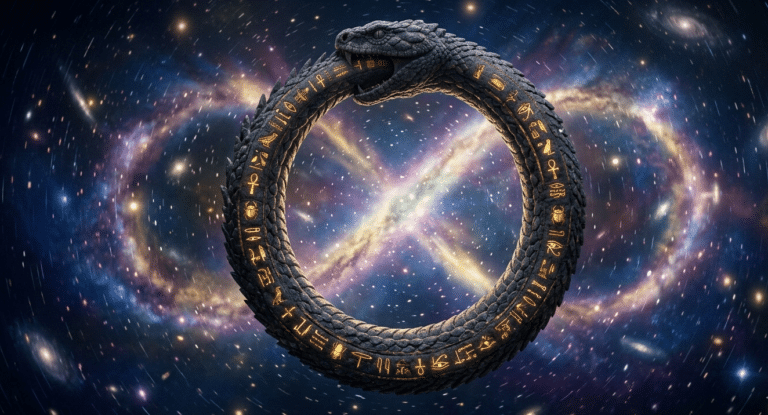
The Ouroboros — a serpent eating its own tail — is among the oldest symbols ever recorded. Its earliest known appearance comes from the Egyptian Enigmatic Book of the Netherworld, found in the tomb of Tutankhamun, circa 1300 BCE. But the concept almost certainly predates the image.
The symbol is paradoxical by design. The serpent destroys itself to sustain itself. It ends where it begins. Creation and destruction are not opposites here — they are a single, continuous act. The Egyptian creator god Atum understood this: he declared that at the end of time, all things would return to primal chaos, and he himself would transform into a serpent. Not death. Return.
This is the “swallower and swallowed” complex at its most concentrated. The serpent’s belly is simultaneously a tomb and a womb. In Egyptian funerary imagery, the solar barque — carrying the sun god through the underworld each night — passes through the body of a great serpent to emerge reborn at dawn. The devouring is the birthing. The darkness is the passage.
The Ouroboros appears independently in Egyptian, Norse, Greek, Hindu, and Mesoamerican traditions — one of the clearest cases of a symbol so fundamental to human cognition that multiple civilizations arrived at it without contact.
=> Deep dive: [The Ouroboros Symbol: Origins, Meaning, and Why It Still Matters]
The Gnostics used it to represent the material world: a closed system, self-referential, inescapable. The alchemists of medieval Europe adopted it as prima materia — the base substance from which all transformation begins. Carl Jungbrought it into the modern psyche as a fundamental archetype of the collective unconscious: the self consuming the self, ego death as the precondition for growth.
The Norse placed Jörmungandr, the World Serpent, in the ocean encircling Midgard. It holds the world together by biting its own tail. When it releases — Ragnarök begins. Chaos, yes. But also: completion.
Modern cosmology found its own version. The cyclical universe model — expansion, contraction, expansion — traces the same form at astronomical scale. The Ouroboros drawn in light years.
An Ouroboros is a completed spiral. The coil closed. The cycle sealed. The serpent and the spiral, again, arrive at the same point.
The Healing Serpent: From Asklepios to the ER
Every hospital in the Western world carries a serpent on its signage. Almost no one asks why.
The rod of Asklepios — a single serpent coiled around a plain staff — is the authentic symbol of medicine. Asklepios, the Greek god of healing, kept sacred serpents in his temples. Patients seeking cures would sleep in the abaton — a sacred hall — where non-venomous snakes moved freely across the floor, the stone, the sleeping bodies of the sick. Healing came through the serpent.
Why the snake? The ancients observed what they couldn’t yet explain biochemically: snakes shed their skin and emerge renewed. They appeared to defeat death through transformation. Venom that killed in large doses could cure in small ones. The Greek word pharmakon captures this perfectly — it means both poison and remedy simultaneously. The same substance. The same creature. The dose determines everything.
The myth of Apollo killing the Python at Delphi carries this ambivalence into the realm of prophecy. Apollo defeats the serpent of wild, chthonic nature — and from that site of conquest, the most authoritative oracle in the ancient world speaks. Order built on the body of chaos. The serpent doesn’t disappear. It becomes the source of the voice.
Ancient accounts describe figures like Melampus and Cassandra receiving the gift of prophecy after serpents cleaned their ears — granting them the ability to understand the language of animals, to hear what others could not. The serpent as the medium of hidden knowledge. The creature that whispers what daylight conceals.
In Anatolia, this theme finds one of its most haunting expressions: Şahmeran, the queen of serpents. Part woman, part snake, she dwells in an underground realm of wisdom, trusting a human who eventually betrays her. She is captured and killed — but her flesh, when eaten, transmits her knowledge. Whoever consumes her becomes a healer. Whoever consumes more becomes a king. Wisdom is not given here. It is extracted from the serpent’s body, at a cost.
The caduceus — two serpents on a winged staff — belongs to Hermes, messenger of gods, guide of souls, patron of boundaries and those who cross them. Its use as a medical symbol is technically a 19th-century American error: the U.S. Army Medical Corps adopted it in 1902, confusing it with Asklepios’s rod. But perhaps the error reveals something true. Hermes guides the living and the dead. Medicine, too, operates at that threshold.
The Serpent Across Cultures
Egypt held two serpents simultaneously. The cobra goddess Wadjet protected pharaohs and crowned kings. The cosmic serpent Apophis (Apep) — embodiment of chaos and darkness — threatened to swallow the sun each night. Ra’s solar barque fought Apophis in the underworld every single night. Every dawn was a victory. Every sunset was a return to battle. The serpent that protected and the serpent that destroyed were equally necessary to keep the world running.
India developed the most elaborate serpent cosmology on earth. The Nagas — semi-divine serpent beings — guard treasures, inhabit rivers, demand reverence. Ananta (Shesha), the cosmic serpent, holds the universe balanced on his thousand heads while Vishnu sleeps between creation cycles. The world rests on a serpent. Kundalini sleeps in the spine. The serpent here is not a threat to cosmic order. It is the axis around which order turns.
China and the broader East Asian tradition draw a sharp line that Western mythology rarely manages. The Chinese dragon — scaled, coiling, waterborne — is not a guardian of buried gold or a destroyer of villages. It is a channel: a bringer of rain, a regulator of rivers, a conduit of heaven’s fertility toward earth. Where the Western serpent or dragon blocks — hoarding treasure, demanding tribute, guarding thresholds — the Eastern dragon flows. It delivers. The serpent in the West is matter resisting spirit. In the East, it is the current that carries spirit into the world.
Mesoamerica synthesized serpent and bird into Quetzalcoatl — earth and sky unified, matter married to spirit. The feathered serpent as the integration of opposites. This theme — the serpent mediating between lower and higher realms — appears independently in Gnostic, alchemical, and Hindu traditions across cultures that had no contact with each other.
Norse mythology placed serpents at both extremes of the cosmos. Jörmungandr encircles the world in the ocean’s depths — chaos contained, for now. Níðhöggr gnaws ceaselessly at the roots of Yggdrasil, the world tree. Entropy as a cosmic function. The serpent that cannot be stopped, only delayed.
Indigenous Australia holds perhaps the oldest continuous serpent worship on earth. The Rainbow Serpent — creator, shaper of landscape, bringer of rain — is a generative being that carved the rivers and breathed life into the land. The serpent as the first artist. The first geographer.
In ancient Greece, rivers carried the serpent’s nature directly into their names: Ophis, Draco. The Rhine, the Volga, the Tiber — great rivers whose flooding, retreating, nourishing, and drowning behavior was explained in antiquity through serpentine or draconic divinities. A river that moves in curves, that swells and recedes without warning, that sustains and destroys in equal measure: a serpent by any other description.
Jung, Archetypes, and the Serpent in the Unconscious
Carl Jung spent decades mapping the symbols that recur across unconnected cultures. The serpent appeared everywhere — in dreams, in myths, in the artwork of patients who had never studied mythology, drawn from a depth that felt prior to learning.
His conclusion: the serpent is a primordial archetype — an image embedded in the collective unconscious, inherited not culturally but psychologically. It represents the deepest, most instinctual layers of the psyche: transformation, the shadow self, hidden knowledge, the dangerous power that coils below the threshold of consciousness.
Jung connected the serpent to the shadow — the repressed, unacknowledged aspects of the self. The creature that lives underground. That moves without warning. That sheds what it no longer needs and emerges from its own discarded skin. In Jungian terms, confronting the serpent in a dream means confronting what you have refused to see in yourself.
Some Gnostic sects — particularly the Ophites, who took their name from the Greek word for serpent — venerated the Eden serpent as a liberator. The creature that gave Adam and Eve gnosis, self-knowledge, the capacity to see clearly. Not a tempter. An initiator. The Demiurge — the lesser god who built the material world — wanted humans ignorant. The serpent wanted them awake.
Jung noted that the serpent in dreams also functions like a labyrinth: it doesn’t go straight. Its path is coiling, doubling back, circling. The psyche, too, doesn’t resolve in straight lines. The winding descent into the unconscious follows the serpent’s own geometry.
Isbell’s neurological theory and Jung’s psychological one describe the same phenomenon at different scales. The serpent grips human attention from below — through the nervous system — and from above — through the symbolic imagination. That double grip is why no other symbol has proven so durable.
The Modern Serpent: Tattoos, Tarot, and Code
The modern serpent doesn’t reinvent its meaning — it compresses thousands of years of symbolism into a single, portable image.
In tarot, the Devil card — often depicted with serpents — represents materialism, addiction, and the chains of unconscious compulsion. The Wheel of Fortune shows a serpent descending as fortune rises. The Temperance card, in some traditions, connects to serpentine imagery associated with reincarnation — the soul’s passage through cycles of form. The serpent doesn’t judge. It marks the turning.
In tattoo culture, the serpent is one of the most requested designs globally. Its wearers choose deliberately: transformation, danger, wisdom, rebirth. The Ouroboros tattoo has become a modern shorthand for cyclical thinking, resilience, and a specific kind of philosophical depth — the kind that has made peace with impermanence.
In film and literature, the serpent retains its primal charge. Voldemort’s Nagini in Harry Potter — a horcrux, a fragment of fractured soul given animal form. The serpents threaded through True Detective season one, coiling through its imagery of cyclical violence and the flat circle of time. Game of Thrones’ House Targaryen sigil — serpentine dragons, ancestral power, the dangerous inheritance of fire.
In cryptocurrency, the Ouroboros appears as the name of Cardano’s proof-of-stake consensus protocol. A self-sustaining cycle of validation, named after an ancient symbol of self-perpetuation. Ancient image. Digital infrastructure.
In depth psychology and contemporary wellness culture, Kundalini yoga has moved from the ashrams of India to studios in Brooklyn and Berlin — the coiled serpent at the spine’s base now a framework for somatic healing, trauma integration, and the mapping of embodied energy.
The serpent moves through time the way it moves through grass: without legs, without noise, and consistently faster than expected. We did not choose this symbol. It chose us — written into our neurons long before we had words for fear, or wonder, or the strange suspicion that life and death might be the same thing, coiled around each other, each one swallowing the other’s tail.
Did You Know?
The highest angels in the biblical hierarchy — the Seraphim, beings of pure fire who stand closest to the divine throne — take their name from saraph: the Hebrew word for burning, fiery serpent. The same root that names the creature condemned at the garden’s gate names the beings who dwell in God’s immediate presence. In the oldest layers of biblical language, the serpent and the angel were not opposites. They were the same word, reaching in two directions.
FAQ
What does the serpent symbolize in mythology?
The serpent symbolizes transformation, duality, hidden knowledge, healing, and immortality across most world mythologies — though its specific meaning shifts dramatically between cultures, ranging from divine protector to cosmic destroyer to initiator of wisdom.
Why is the snake a symbol of medicine?
The snake’s association with medicine derives from the Greek god Asklepios, whose sacred serpents were used in healing temples; the rod of Asklepios — a single serpent on a plain staff — remains the authentic symbol of medicine, distinct from the caduceus of Hermes.
What is the Ouroboros?
The Ouroboros is an ancient symbol of a serpent eating its own tail, representing cyclical time, eternal return, and the unity of creation and destruction; it appears independently in Egyptian, Norse, Greek, Hindu, and Mesoamerican traditions.
Why did some religions demonize the serpent while others worshipped it?
Monotheistic and solar religions that displaced older earth-based cults frequently reassigned the meaning of serpent symbolism — transforming a sacred creature associated with goddess worship and chthonic wisdom into a symbol of evil and deception.
What is the difference between the caduceus and the rod of Asklepios?
The rod of Asklepios features one serpent on a plain staff and is the authentic symbol of medicine; the caduceus features two serpents on a winged staff and belongs to Hermes — its widespread use in American medical contexts stems from a 19th-century misidentification.
What did Carl Jung say about serpent symbolism?
Jung identified the serpent as a primordial archetype of the collective unconscious, representing the shadow self, transformation, and the deepest instinctual layers of the psyche — an image so fundamental that it appears across cultures with no historical contact.